
Robert E. Simon Jr. planned Reston around seven goals: plenty of ways to use free time, housing for every income and stage of life, planning centered on the individual, jobs close to home, shops and recreation from the first day, beauty in buildings and landscape, and a profit for the developer. Sixty-two years after the first families moved in, we graded Reston on each one.
Simon bought 6,750 acres of western Fairfax County farmland and woods in 1961 with proceeds from his family’s sale of Carnegie Hall. He set the goals before the first townhouse went up at Lake Anne, and Fairfax County’s current plan for Reston still carries one of them, closely paraphrased, as a planning principle.
Simon’s seven goals cover leisure, housing, dignity, jobs, amenities, beauty and profit
The wording below appears in Reston: The First Twenty Years, the 1985 history by Tom Grubisich and Peter McCandless, and in the version Reston Now printed in Simon’s 2015 obituary. Simon’s planners, the firm of Whittlesey & Conklin, worked from these goals as they drew the master plan in 1962 and 1963.
- “That the widest choice of opportunities be made available for the full use of leisure time. This means that the New Town should provide a wide range of cultural and recreational facilities as well as an environment for privacy.”
- “That it be possible for anyone to remain in a single neighborhood throughout his life, uprooting being neither inevitable nor always desirable. By providing the fullest range of housing styles and prices (from high-rise efficiencies to six-bedroom townhouses and detached houses) housing needs can be met at a variety of income levels and at different stages of family life. This kind of mixture permits residents to remain rooted in the community if they so choose (as their particular housing needs change). As a by-product, this also results in the heterogeneity that spells a lively and varied community.”
- “That the importance and dignity of each individual be the focal point for all planning, and take precedence for large-scale concepts.”
- “That the people be able to live and work in the same community.”
- “That commercial, cultural and recreational facilities be made available to the residents from the outset of the development (not years later).”
- “That beauty (structural and natural) is a necessity of the good life and should be fostered.”
- “Since Reston is being developed from private enterprise, in order to be completed as conceived it must also, of course, be a financial success.”
Reston earns four A-range grades, two B’s and one Incomplete
1. Leisure time: A, because Reston built the pools, paths and lakes and still runs them
Reston Association maintains 15 pools, 54 tennis courts, 55 miles of paved pathways and more than 1,300 acres of open space, including four lakes and the 72-acre Walker Nature Center. Lake Fairfax Park, run by the Fairfax County Park Authority, adds a fifth lake. Reston Community Center, paid for by a special tax district on Reston properties, adds an indoor pool, a theater and year-round classes.
Simon also asked for “an environment for privacy,” and long stretches of those pathways run behind houses and through the woods, away from the roads.
2. A home for every stage of life: B-, because the housing types exist but the price steps are steep
Reston has every housing type Simon listed: high-rise condominiums, townhouses and detached houses, often within a short walk of one another. A household can move from a condo to a townhouse to a detached house and back to a condo without leaving Reston.
In July 2026 the median Reston condominium sold for $391,000, the median townhouse for $709,000 and the median detached house for $1,106,625, according to Bright MLS. A family trading up from a condo to a detached house nearly triples its purchase price.
3. Dignity of the individual: Incomplete, because Fairfax County still measures new Reston development against it
Fairfax County’s Board of Supervisors adopted a rewritten Reston Comprehensive Plan in September 2023. Its twelfth planning principle reads: “The dignity and worth of the individual continue to be the focal point for Reston planning, creating opportunities to improve and enhance equity.” At the meeting where the Board voted, Hunter Mill District Supervisor Walter Alcorn said that some of Simon’s principles “are still challenging today,” and he singled out this one as “rather unusual.”
Simon’s company also sold Reston homes to buyers of every race from the town’s opening in 1964, four years before the federal Fair Housing Act banned housing discrimination, and Alcorn called Reston “the first racially open community in the Commonwealth of Virginia.” Encyclopedia Virginia reports that Simon said the stand cost him potential lenders. The principle will guide Reston rezonings for years to come, so we are holding the grade open.
4. Live and work in the same place: B, because the jobs are here but six in seven working residents leave for work
Reston has more than twice as many jobs as working residents. Census Bureau commuting data for 2023 counts 73,299 primary jobs located in Reston and 31,455 Reston residents who hold one. A primary job is each worker’s highest-paying job, which keeps anyone with two jobs from being counted twice.
Only 4,467 of those residents, about one in seven, work inside Reston. Just over half work somewhere in Fairfax County, Reston included. Simon asked that people “be able to” live and work in the same community, and on that wording Reston passes. In practice, six in seven work somewhere else.
5. Shops and recreation from day one: A, because Lake Anne’s plaza and shops opened about a year after the first families arrived
Simon wanted facilities “from the outset of the development (not years later).” The first families moved into Lake Anne townhouses in the fall of 1964, and Lake Anne Village Center, with its plaza and shops on the lake, opened in December 1965. Hunters Woods, Tall Oaks, South Lakes and North Point followed the same model, each village center planned so most homes would sit within walking distance. Four of the five still operate. Tall Oaks closed and was demolished in 2018, and townhouses and condominiums now stand on the site.
6. Beauty: A-, because the woods and design review survived sixty years of growth
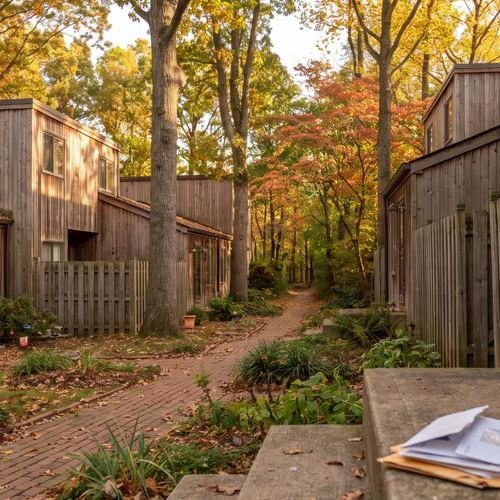
More than 1,300 acres of Reston stay in common open space. Reston Association’s Design Review Board approves exterior changes to homes in its neighborhoods, down to paint colors and fences, which keeps the older clusters looking the way their architects drew them. (A cluster is a small group of homes that shares common land and has its own association.)
We hold back the full grade for the office parks along the Dulles Toll Road, which in our view were laid out for drivers, with many buildings set behind surface parking.
7. Financial success: A, because the plan got built, though not by Simon
Simon’s own company ran short of money within a few years. Gulf Oil lent him $15 million in 1964, took over management and pushed him out by 1967. Gulf kept building until 1978, when Mobil bought the remaining 3,700 undeveloped acres for $31 million. Mobil’s land company opened the first phase of Reston Town Center in 1990, according to George Mason University’s Reston@50 archive.
The seventh goal asks for profit “in order to be completed as conceived,” and on that test Reston succeeded. Gulf and Mobil built out the village centers, lakes and pathways of Simon’s plan. The town grew more slowly than projected. The 1963 master plan expected about 75,000 residents by 1980, and the 2020 census counted 63,226. Simon lost control of his company, but the town he drew got built.
The report card: A’s for amenities and beauty, a B- for housing range
| Goal | Grade | The figure behind it |
|---|---|---|
| 1. Leisure time | A | 15 pools, 54 tennis courts, 55 miles of paths |
| 2. A home for every stage of life | B- | Condo median $391,000, detached median $1,106,625 |
| 3. Dignity of the individual | Incomplete | Still principle No. 12 in the county’s 2023 plan |
| 4. Live and work in the same place | B | 73,299 jobs, but only 1 in 7 working residents works here |
| 5. Facilities from day one | A | Lake Anne Village Center opened about a year after the first families |
| 6. Beauty | A- | More than 1,300 acres of open space |
| 7. Financial success | A | Built out by Gulf and Mobil; Reston Town Center opened 1990 |
Simon’s goals also account for much of what a buyer meets in Reston today: the Reston Association assessment that pays for the pools and paths, the design review on a new fence, and the village center a short walk away. Our guide to living in Reston explains how each of those works and what it costs, and our post on how Reston got its name covers the initials Simon put on the map.
See something missing or wrong? Email us at [email protected] and we will check it and update the post.