
Herndon Town Council meets Tuesday, September 8 at 7:00 PM in Council Chambers at 765 Lynn Street, and the first item on the work session agenda asks a question with a very wide price range. What should the town spend to keep golf balls out of the back yards on Burwick Drive?
The town posted the packet Friday afternoon. Item 2.a. carries a 12-page memo from Deputy Town Manager Kirstyn Jovanovich to Town Manager Dan Hoffman, dated August 6 and marked revised after fresh netting estimates arrived on July 29. It covers golf balls leaving Hole #9 at Herndon Centennial Golf Course and landing in the Estates at Eagle Lie.
How the request reached Council
Residents began raising this in 2024. That July, a homeowner on Burwick Drive emailed Mayor Olem and Golf Course General Manager Michael Mueller about broken windows and damage to vehicles and siding, and handed the town a petition signed by neighbors asking for netting. Herndon answered by realigning the Hole #9 tee boxes to shift play away from the houses, finishing that work in June 2025. Residents returned at a May 2025 town hall and again in April 2026. Staff met the neighborhood on site on June 24, 2026, shared findings, and asked residents to start filing claims so the town would have something to measure.
One claim followed. On July 1, 2026 a Burwick Drive homeowner filed for siding damage, the only claim from this neighborhood since Herndon began tracking claims consistently in 2019. Across the entire course the town averages about three claims a year at roughly $1,000 each. The course hosts about 48,000 rounds annually. The memo’s own claim map puts most golf ball damage reports somewhere else entirely: the Community Center parking lot, and Crestview Drive near the 7-Eleven.
What staff concluded
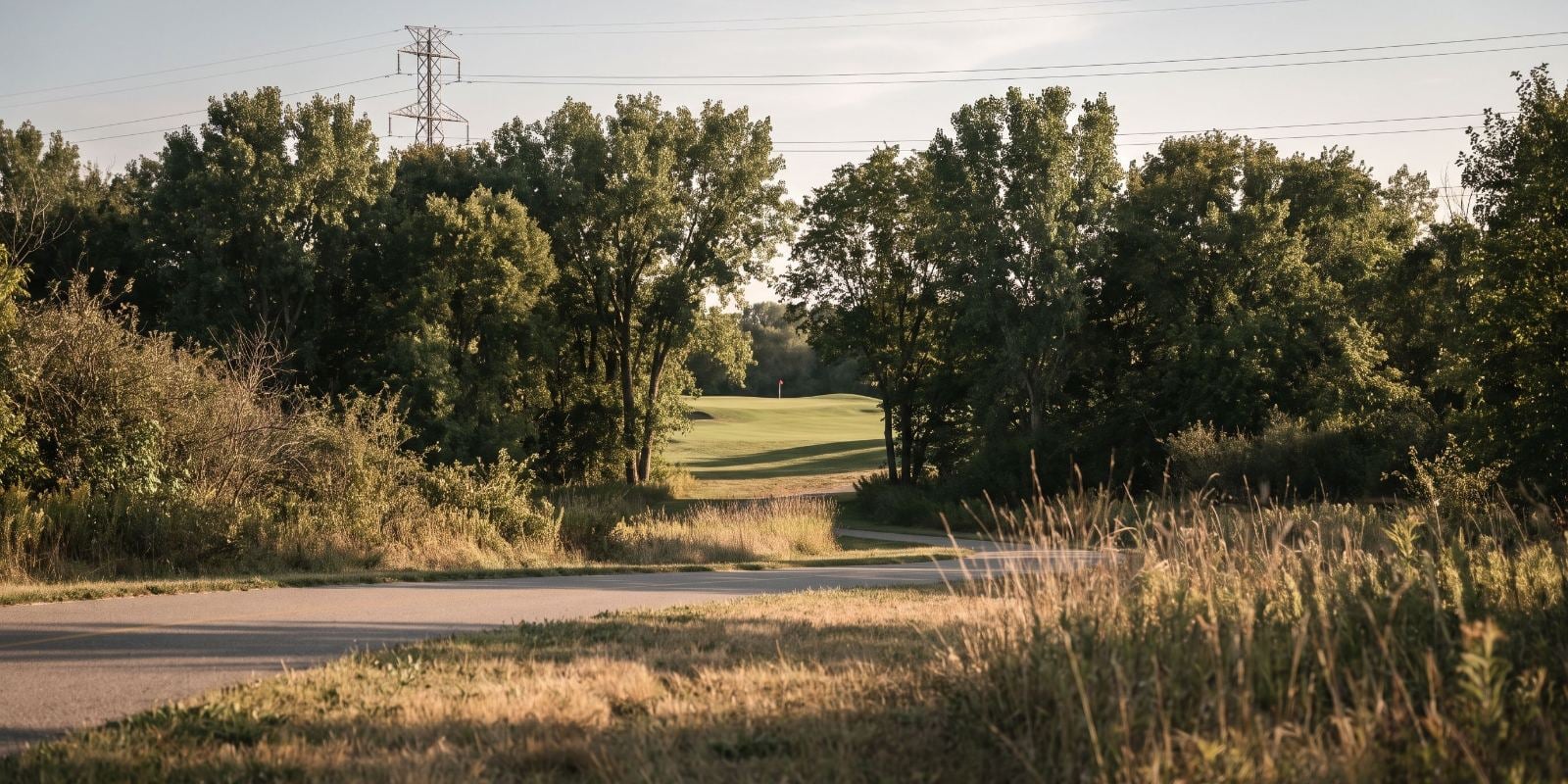
The memo does not point at golfers. Reaching the nearest affected property from active play would take a shot more than 40 degrees off the fairway centerline from the white tees, well outside the 200-foot cone of safety for the hole, which ends in the woods between the course and the W&OD Trail. Staff offers other explanations: wildlife carrying balls off the course, maintenance equipment displacing balls that came to rest in the perimeter vegetation, and range balls turning up on neighboring properties even though range balls never enter play on Hole #9.
The bigger change came in April 2026, when Dominion cleared invasive vegetation from the W&OD corridor behind the houses under its powerline easement. That work thinned the screen between the fairway and the yards, and the memo says it likely contributed to the increase residents describe. Dominion plans to replant this fall with a mix of deciduous and evergreen trees and shrubs.
The cost ladder
Staff priced netting by span and height. At 40 feet tall the estimate runs $226 per linear foot; at 60 feet it runs $326. That produces $79,100 for a 350-foot span at 40 feet, $114,100 for the same span at 60 feet, $146,700 for 450 feet at 60 feet, and $244,500 to run the full 750 feet from the start point to the green.
Above 60 feet the arithmetic breaks. The job stops being a fence installation and becomes an engineered structure with two-pole configurations, deeper foundations and specialized drilling, at more than $2,700 per linear foot. Raising that same 450-foot span to 80 feet costs $1,248,874.
Staff adds a caveat worth holding onto. Sixty feet of netting sits below parts of the existing tree canopy, which runs roughly 75 feet through this stretch. Netting at that height would stop balls traveling through the buffer rather than over it.
The two options
Option 1 plants canopy and evergreen trees along the course tree line, closes the vegetation gap near the 150-yard marker, installs signage reminding golfers they are responsible for damage they cause, and folds the netting question into the Golf Course Master Plan the town is preparing to launch. Vegetation runs $33,000 to $45,000, with master planning money already in the FY 2027 budget.
Option 2 adds the minimum netting span, 450 linear feet at 60 feet, for a package of $179,700 to $191,700. It requires Council action, a budget amendment, and capital from the Golf Course Enterprise Fund.
What this means for owners and buyers on the course
The golf course is classified as a park, so sovereign immunity generally protects the town and liability rests with the golfer who hit the ball. Herndon runs the Good Neighbor Program anyway, funded through the golf enterprise, which reimburses property damage after Risk Management investigates and the general manager authorizes payment.
Anyone shopping a home that backs the course or the trail now has a public document that quantifies the claim history, the town’s read on the cause, and the process for getting a broken window paid for. Owners on those streets have something in the file too, since the memo says routine tee shots are probably not the source and the buffer is being replanted. Homes backing golf courses usually carry a premium in Herndon. This is a rare case where a buyer can read exactly what the town knows before writing the offer.
We track the filings and agendas that shape what it is like to live on a specific street in Herndon and Reston, usually before anyone else writes about them. If you own a home along the course or the W&OD, or you are weighing one, we can walk you through what the town record shows and what it means for value. Reach out any time.