
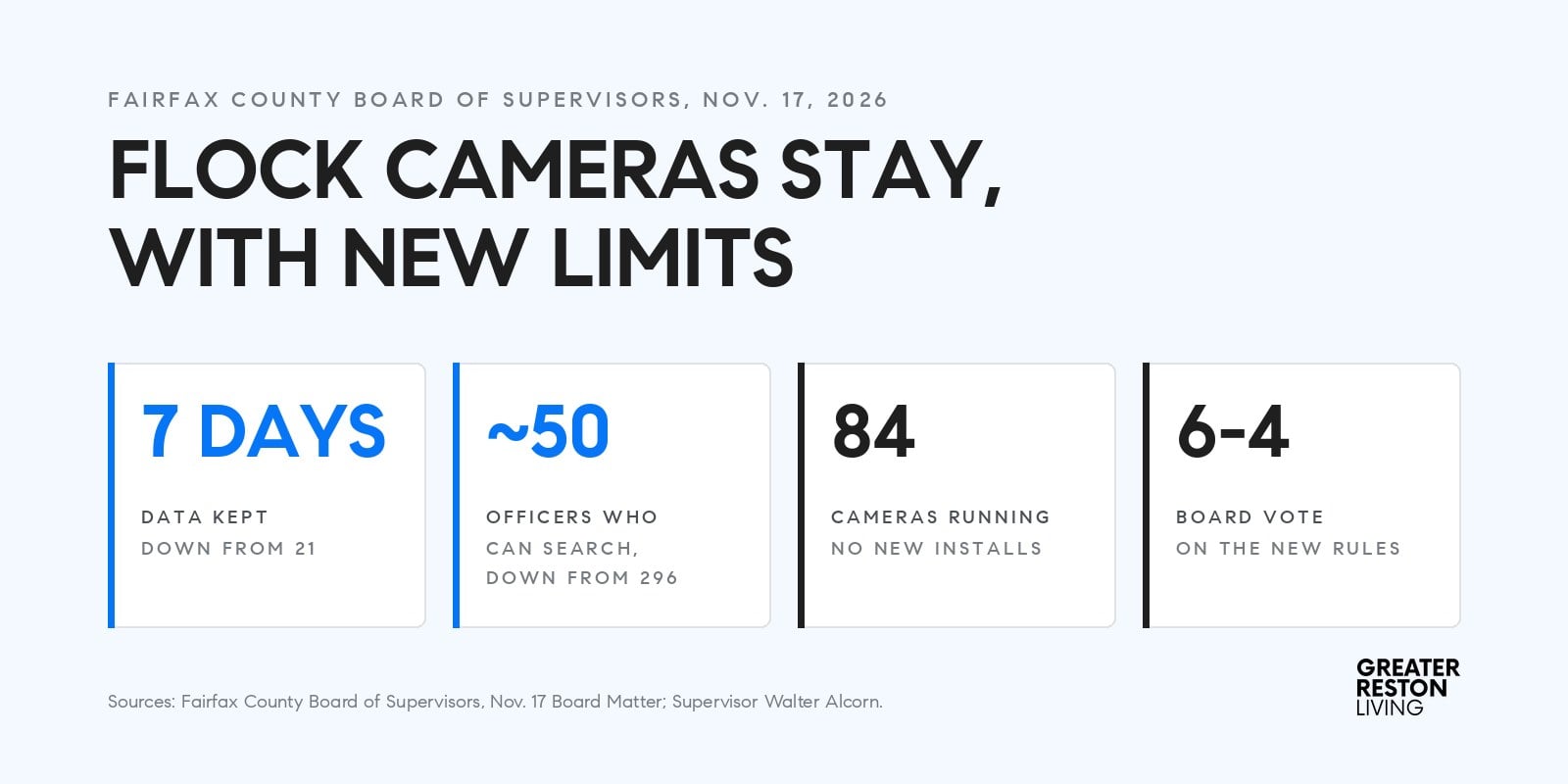
Not yet. Fairfax County police will keep running their 84 Flock license plate cameras, under tighter limits the Board of Supervisors approved 6-4 on Tuesday, Nov. 17. Police will keep the data for seven days instead of 21, and only about 50 officers will be able to search it. Supervisors also told county staff to keep testing other vendors and to move the county away from Flock Safety, the Atlanta company that makes the cameras. They set no date for that switch.
Walter Alcorn, who represents Reston on the board, voted yes. On Oct. 20 he said that if the board were voting that day, he would end the county’s Flock contract, as we reported at the time. In his newsletter the day after the vote, he wrote that moving the county’s plate data onto county-owned servers “calls Flock’s bluff.”
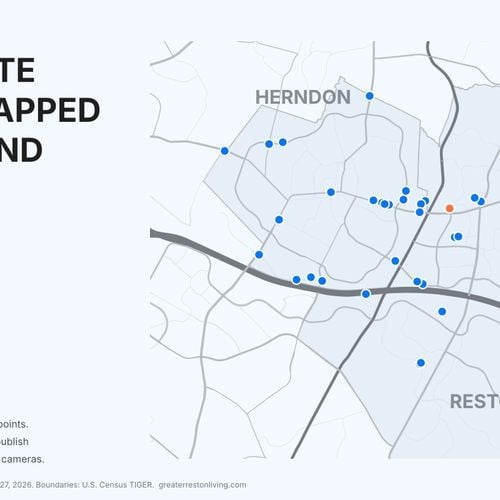
Jimmy Bierman, whose Dranesville District includes the Town of Herndon, voted no and wanted the county out of its Flock relationship now. The Herndon Police Department runs its own Flock cameras under a separate town contract, and the county’s new rules do not cover them. Four of the five newcomers Herndon voters elected to the Town Council on Nov. 3 oppose the town’s cameras.
The board kept the 84 cameras and narrowed who can search the data
An automated license plate reader, or ALPR, is a camera that photographs passing vehicles, turns each plate into searchable text and checks it against lists of stolen cars, wanted people and missing persons. Fairfax County police have used Flock’s pole-mounted readers since late 2022, starting with a trial. The department also runs 714 Axon readers mounted on patrol cruisers, and supervisors left those out of the Nov. 17 rules.
In his board matter, an item a supervisor raises at a board meeting, Board Chairman Jeff McKay directed the county executive, the police department and the county’s technology office to:
- Keep the freeze on new cameras. Supervisors stopped new stationary Flock installations on Sept. 15, and that pause stays in place.
- Hold plate data for seven days. Virginia allows police to keep it for up to 21 days unless it becomes part of a case, and the county had been keeping it that long.
- Limit searches to the Real Time Crime Center. The center, the department’s central unit for camera and data work, has about 50 sworn officers. Alcorn’s newsletter puts the number of officers with search access today at 296.
- Stop sharing with other police agencies unless the law requires it, until the Metropolitan Washington Council of Governments, the association of local governments around Washington, sets up a regional model.
- Move the data onto county servers. Staff will begin moving plate data from the county’s Amazon cloud account to servers the county owns on its own property, and make sure Flock cannot manage or reach data from county cameras.
- Add audit standards for the system.
- Publish where the cameras stand and the criteria for placing them, such as the property owner’s approval and the need for the data.
- Publish guidelines for private camera owners and ask them to adopt the rules voluntarily.
- Keep evaluating other vendors and transition away from Flock’s technology.
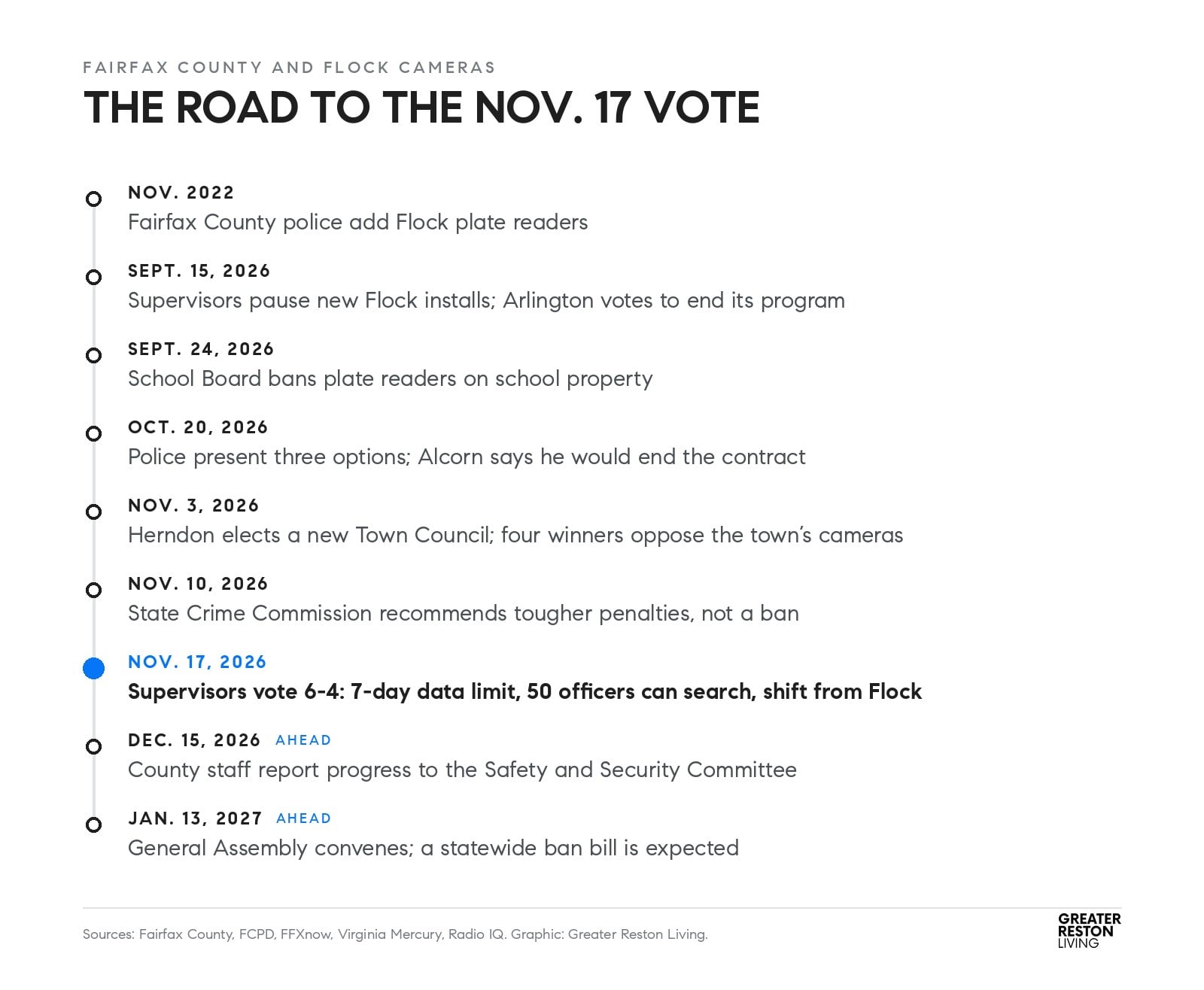
The board set no deadline for the server move or the vendor change. County staff will report on progress, and on timelines for anything unfinished, at a special meeting of the board’s Safety and Security Committee on Dec. 15 at 1:30 p.m., according to the county’s announcement.
Police tie plate readers to 1,647 cases from November 2022 through Oct. 12, including 573 recovered stolen vehicles, 60 missing people found and 67 recovered guns, according to the department’s October presentation. Those figures cover every plate reader vendor the county has used, not Flock alone. Police Chief Kevin Davis told supervisors the department monitors how officers use the system and has found no misuse, NBC4 reported.
Six supervisors voted yes, and four wanted to end the Flock relationship
| Supervisor | District | Vote |
|---|---|---|
| Jeff McKay | Chairman, at large | Yes |
| Walter Alcorn | Hunter Mill | Yes |
| Rodney Lusk | Franconia | Yes |
| Kathy Smith | Sully | Yes |
| Pat Herrity | Springfield | Yes |
| Dan Storck | Mount Vernon | Yes |
| Jimmy Bierman | Dranesville | No |
| Dalia Palchik | Providence | No |
| Rachna Sizemore Heizer | Braddock | No |
| Andres Jimenez | Mason | No |
McKay called his motion “a compromise” that reflects where he believes most county residents stand, FFXnow reported. He said county police have not been accused of misusing the system.
“I think that we need to immediately end our relationship with Flock,” Bierman said, according to NBC4. Sizemore Heizer called the question nonpartisan and pointed to localities in Texas, Arizona, Missouri, California and Virginia that have paused the technology.
Lusk, who chairs the Safety and Security Committee, said he wants to see where the county stands in December before deciding what to do next.
Alcorn backed the motion because the county will take the data out of Flock’s reach
In his Oct. 20 statement, Alcorn objected that the county’s Flock data was not encrypted and not kept on a private or closed network, and he said he was not convinced others were not misusing it. He floated a closed-network system, possibly a regional one, and named the Council of Governments as a model for cooperation across county lines.
Supervisors adopted two of those ideas in the motion Alcorn backed: county-owned servers that Flock cannot reach, and a Council of Governments model before the county resumes sharing with other agencies. They kept the Flock cameras running in the meantime. In his Nov. 18 newsletter, Alcorn wrote that Flock says it does not access or monitor footage from county-owned cameras, and that the motion removes the company’s ability to do so. “This move calls Flock’s bluff,” he wrote.
Residents who want to ask him about the vote can find him at his holiday open house on Wednesday, Dec. 9, from 4 to 6 p.m. at the North County Governmental Center on Cameron Glen Drive.
DeFlock Fairfax said the vote surprised and disappointed its members
DeFlock Fairfax, the local group campaigning to take the county’s plate readers down, said in a statement that the vote surprised and disappointed its members. By continuing to use the cameras without the group’s input, the county further damaged the public’s relationship with police, the group said, according to NBC4.
The group wants plate readers gone from the county entirely, not replaced with another company’s. Our explainer on Flock cameras and DeFlock covers the volunteer camera map, the group’s history and the case each side makes.
Herndon’s police run their own 10 cameras, and most of the incoming council opposes them
The Town of Herndon has its own police department and its own Flock contract, so the county’s limits do not apply inside the town. As of Oct. 27, the town’s public Flock dashboard listed 10 cameras and a 21-day retention period, and those cameras had recorded 324,273 vehicles over the previous 30 days.
Outside the town limits, in Oak Hill and the Dranesville area north of town, Fairfax County police patrol, and the county’s new rules apply to the cameras they run.
Herndon voters elected five newcomers to the six-member council on Nov. 3: Sabrina Bruce, Yasmin Shafiq, Meron Yohannes, Josif Ezekilov and Justin Britt, according to unofficial results reported by FFXnow. Vice Mayor Clark Hedrick was the only incumbent reelected, and Mayor Keven LeBlanc won a second term unopposed. Bruce, Shafiq, Yohannes and Ezekilov all opposed the police department’s use of Flock during the campaign, and Ezekilov told FFXnow he would push to end the town’s contract on day one. A police spokesperson said in October that the department takes direction from the Town Council. The new council takes office in January.
Cameras owned by HOAs and businesses stay outside the county’s control
County police can also tap about 120 Flock cameras that businesses and homeowners associations own, according to the department’s October presentation. McKay wrote in his board matter that the county “has no designated legal authority to control the equipment it does not own.” The county will publish its guidelines and encourage private owners to follow them.
A Reston cluster or condo board with a plate reader can check its contract against those guidelines once the county publishes them, starting with how long the vendor keeps footage and whether the association shares it with police. Our explainer lists four questions boards can ask now.
County staff report back Dec. 15, and the General Assembly takes up plate readers in January
- Dec. 15, 1:30 p.m.: County staff update the Safety and Security Committee on the server move, the audit standards and the vendor search.
- January: Herndon’s new Town Council takes office.
- Jan. 13: The General Assembly convenes. On Nov. 10, the Virginia State Crime Commission recommended tougher penalties for misusing plate reader data and changes to the state’s data-sharing rules, but not a ban, the Virginia Mercury reported. State Sen. Lashrecse Aird of Petersburg has said she will bring a bill to ban plate readers statewide.
See something missing or wrong? Email us at [email protected] and we will check it and update the post.