
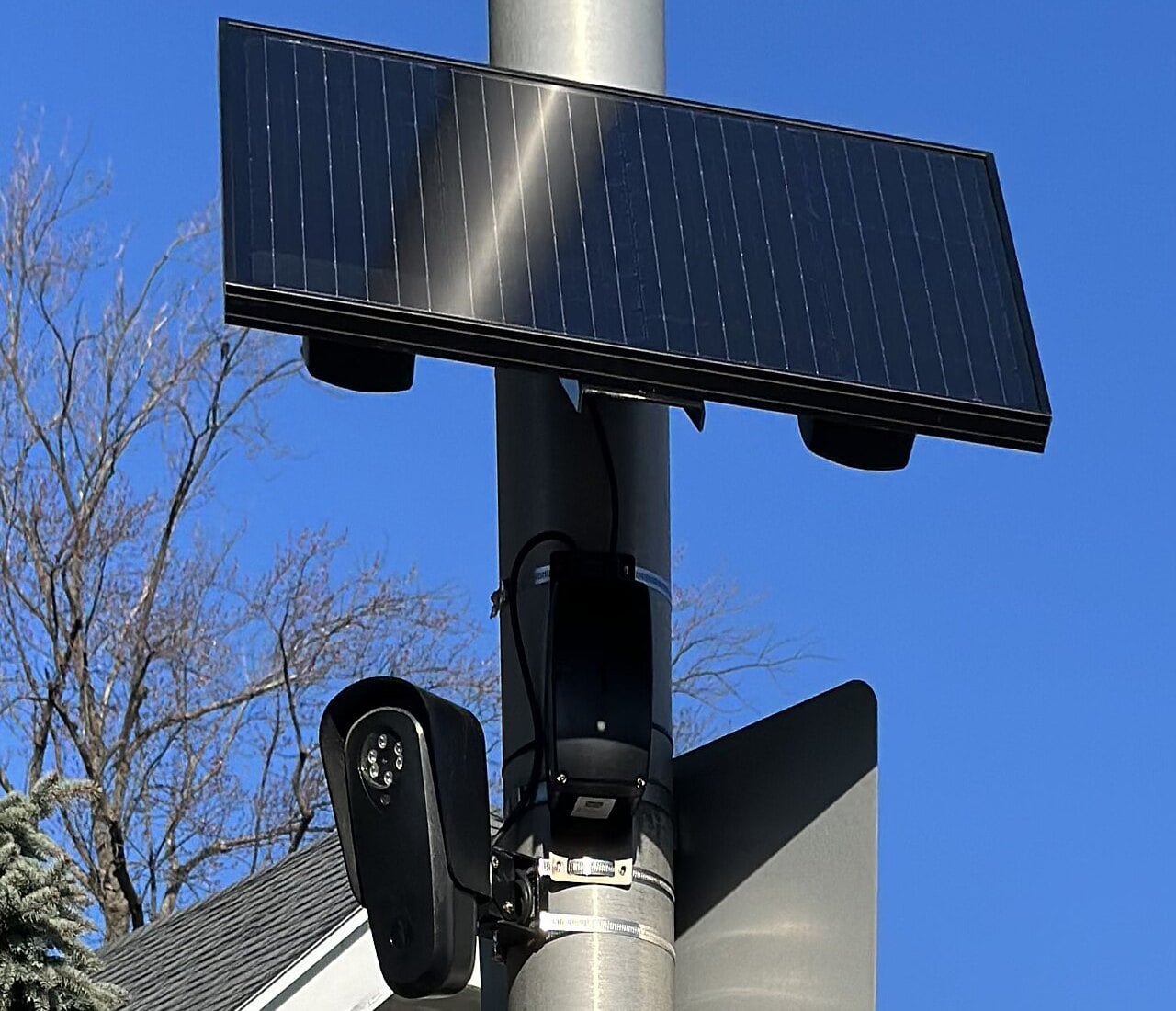
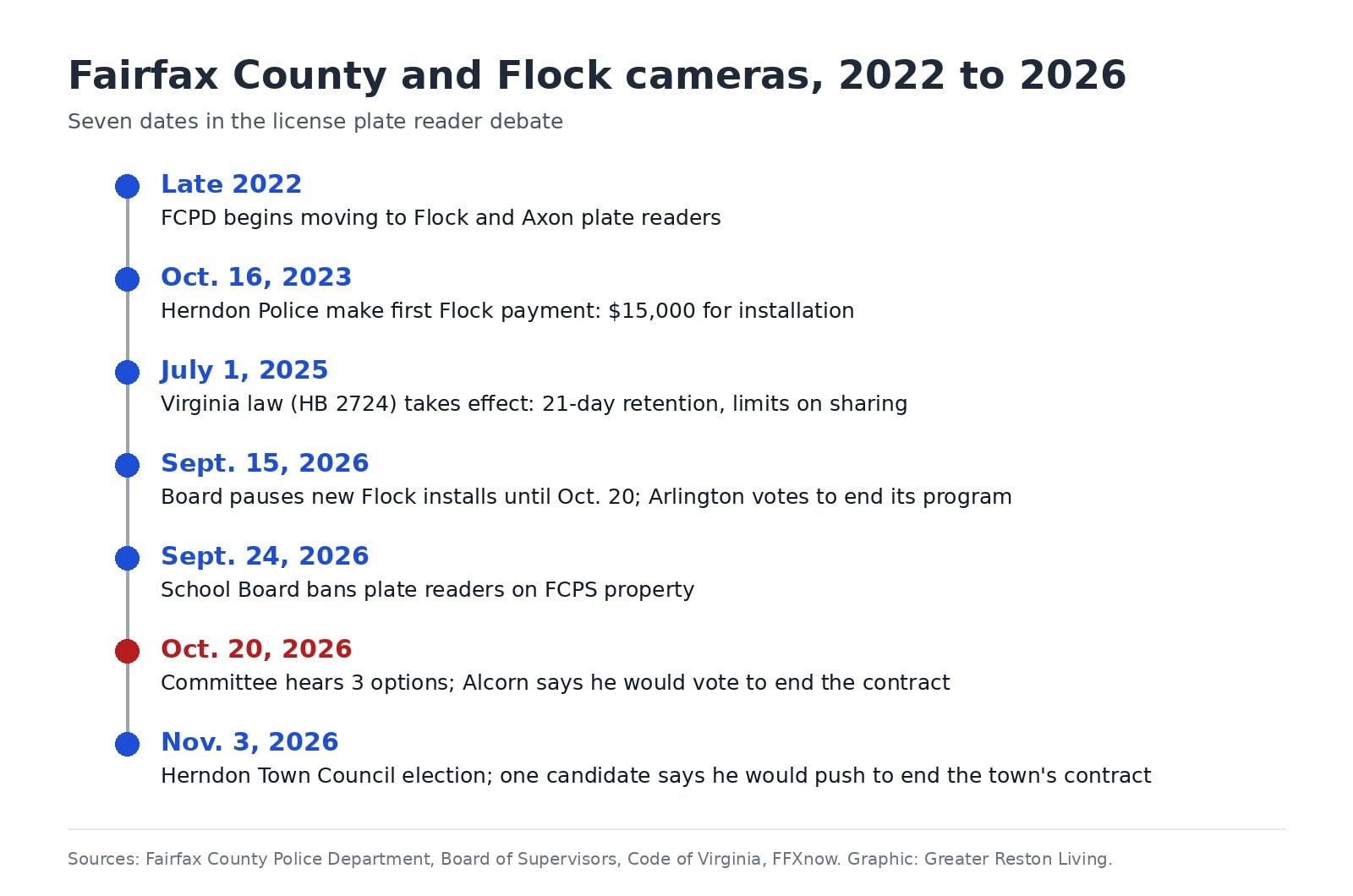
Walter Alcorn, who represents Reston and the rest of the Hunter Mill District on the Fairfax County Board of Supervisors, said on Oct. 20 that he would vote to end the county’s contract with Flock Safety, the company behind the license plate cameras mounted on poles around the county.
He said it during a two-hour discussion at the Board’s Safety and Security Committee, and his office posted a written statement the same day. The committee took no vote. Nothing changes on the street yet: the county’s 84 Flock cameras keep running. The Board’s September pause on new installations was set to last until this meeting, and supervisors have not voted on what comes next.
Alcorn is one of ten supervisors, so his position does not end anything on its own. It does put the Reston area’s representative on record against the vendor at a moment when Arlington and Henrico County have ended their Flock contracts, Richmond has said it will not renew its own, and Herndon’s Flock contract has become a Town Council campaign issue.
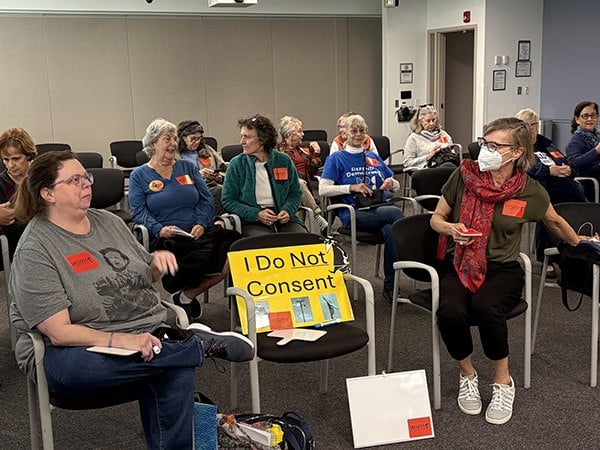
Alcorn objects to how Flock stores the data and to who else might use it
- AI raises the stakes. He said new artificial intelligence tools raise concerns about plate readers “to a whole new level,” and that Flock has drawn opposition from figures as far apart as Ron DeSantis, Greg Abbott and Bernie Sanders.
- The county should avoid enabling surveillance. As the governing body for more than a million residents, he said, Fairfax should be “extra careful to avoid enabling a surveillance state,” including harm that comes from others misusing data the county collects rather than from the county itself.
- He questions how the data are stored. He said the vendor does not encrypt the data and does not keep them on a private or closed network, and that he is not convinced others are not misusing county data.
- The conversation should be regional. Stolen cars and missing people cross county lines, so he wants the discussion to include lawyers, police, data specialists, civil liberties advocates, owners of private cameras and the public, possibly through the Metropolitan Washington Council of Governments. He floated a regional closed-network plate reader system as one idea to study.
Alcorn aimed his statement at the contract “with that vendor” and asked for a broader debate about the tools police use. That leaves room for plate readers from another supplier or a regional system.
Fairfax police run 84 Flock cameras and can tap 120 more owned by HOAs and businesses
An automated license plate reader, or ALPR, is a camera that photographs passing vehicles and converts the plate into searchable text, then checks it against lists of stolen cars, wanted people and missing persons. Fairfax County first used the technology in 2008, according to the police department’s Oct. 20 presentation, and moved to its current Flock and Axon equipment at the end of 2022 and into 2023.
The presentation and the department’s Real Time Crime Center transparency page list the program’s parts:
- 84 stationary Flock cameras operated by the police department.
- About 120 privately owned Flock cameras whose data the department can access. Homeowners associations and commercial property owners buy these for their own property, and the county does not approve them. In the McLean police district alone, the presentation counts 48 private cameras, most of them in the Dranesville supervisor district.
- 712 Axon Fleet 3 plate readers mounted on most police cruisers. (The presentation slide says 714.)
- 21-day retention. Plate data is deleted after 21 days unless it belongs to an investigation.
- Sharing with 168 Virginia agencies, which the transparency page lists. The department says federal and out-of-state agencies do not get access without a court order, and that it does not use plate readers for immigration enforcement. DeFlock Fairfax organizer Matthew Lofgren has countered that some of those agencies have agreements to cooperate with ICE, Annandale Today reported.
- Fewer people with access. The department cut the number of employees who can run searches from 821 to 296, mostly by removing patrol officers, and it reviews every search. No one above the rank of major has Flock access.
The department says it owns the data, Flock cannot sell it, and private camera owners cannot see police data.
Police credit plate readers with 573 recovered cars and 60 missing people
From Nov. 1, 2022, through Oct. 12, 2026, the department counts 1,647 cases in which plate readers helped. Its presentation lists 573 stolen vehicles recovered, 67 guns recovered, 60 missing people located, 938 people arrested on 2,672 charges, and 161 narcotics cases. It puts the value of recovered vehicles at more than $9 million and other recovered property at more than $790,000. The presentation labels these overall plate reader figures, so they cover the cruiser-mounted Axon units as well as the Flock cameras.
In Reston, in November 2025, a plate reader flagged a stolen Toyota Camry in the 1600 block of Reston Parkway, and officers found it in a nearby shopping center and arrested a suspect after a short foot chase, FFXnow reported.
The presentation also walks through cases from elsewhere in the county: a man exposing himself at two schools, a would-be child abductor at a bus stop, a homicide suspect stopped minutes after an alert, and an elderly couple who had been lost on Northern Virginia roads for more than 12 hours. Major Hudson Bull, who runs the Real Time Crime Center, told supervisors, “It has become an essential law enforcement tool,” according to FFXnow.
Staff offered three options, and none of them ends the program
Police gave the Board three choices:
- Keep the current program and continue evaluating other vendors and data-sharing practices. No added cost.
- Keep the current program while testing other vendors that can comply with Virginia law and the department’s own plate reader policy, General Order 424. This carries testing costs.
- Become a closed network. Fairfax would stop sharing plate data outside the county but keep access to privately owned cameras, then evaluate the arrangement after a year. The department warned that a closed network would make it harder to solve crimes that cross jurisdictional lines.
Mason District Supervisor Andres Jimenez asked why ending plate readers altogether was not on the list. Deputy County Executive Tom Arnold said he expected crime to rise without them but told supervisors they “can take whatever action you like,” FFXnow reported.
Ending the Flock contract, as Alcorn proposes, would not end plate readers in Fairfax. The department could keep its 712 cruiser-mounted Axon units or move its stationary cameras to another vendor.
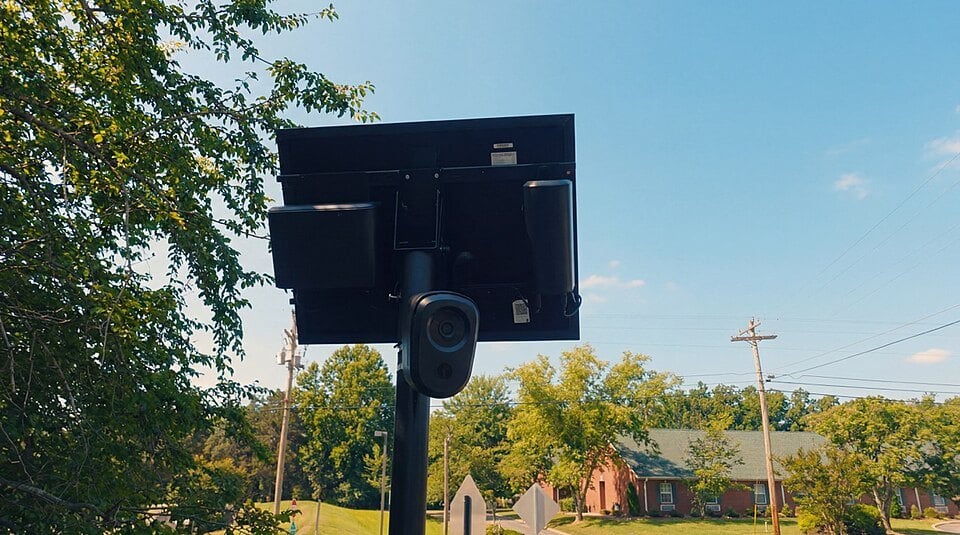
Virginia law already caps retention at 21 days and limits sharing
The General Assembly set the ground rules in 2025. HB 2724 created Section 2.2-5517 of the Virginia Code, which took effect July 1, 2025. The law limits searches, retention and sharing:
- Police may search plate data only for criminal investigations, missing or endangered persons, human trafficking, and alerts on stolen cars, stolen plates and outstanding warrants.
- Data is purged after 21 days unless tied to an open case. Audit records last two years.
- Agencies may not share the data with a database run by another state, a federal agency or a private company, and may not sell it.
- A camera alert alone does not justify a traffic stop. The officer must first confirm the match or have independent reasonable suspicion.
- Willful misuse is a Class 1 misdemeanor, and agencies must report their use to the State Police each year.
The same law exempts plate data from the Virginia Freedom of Information Act, so residents cannot request the records directly. Lofgren has cited that exemption in arguing the public cannot see how the data is used, Annandale Today reported.
Flock says its system blocks federal and out-of-state sharing in Virginia
In September the Board sent Flock CEO Garrett Langley a letter with detailed questions about who can reach county data, whether federal immigration agencies can query it through another Flock customer, and what the company’s AI search tools can do. The letter cited a Kansas police chief who used Flock 228 times over four months to track a former girlfriend.
Langley’s reply says customers own their data, Flock has never sold customer data, and sharing is off by default. For Virginia, he wrote, agencies are “not visible to federal users or out-of-state agencies for sharing requests,” and Flock caps retention at 21 days and blocks searches that appear related to immigration enforcement. He also wrote that Flock has no contract with ICE and that its cameras capture still images and do not use facial recognition.
On storage, the police presentation says Flock data sits in Amazon’s government cloud, approved by the county’s Department of Information Technology review board, and that vendors must meet an industry security standard known as SOC 2. A technical paper in Flock’s response packet says Flock’s data is encrypted at rest. Alcorn said the data are not encrypted. None of these documents explains the difference.
In September, a hacker group that stole a Flock camera found that much of its data was encrypted, but an encryption key sat in an unencrypted section of the camera’s own storage and unlocked thousands of videos and still images of vehicles, Straight Arrow News reported, citing an analysis by 404 Media and Wired. Flock said removing and tampering with its cameras is illegal, that it “takes security seriously,” and asked researchers to report vulnerabilities to the company.
Other supervisors asked for more answers before any vote
Of the supervisors FFXnow quoted from the Oct. 20 meeting, only Alcorn said how he would vote.
- Pat Herrity (Springfield) warned against rushing, called the cameras “incredibly effective” and said, “We don’t talk about victims enough when we talk about public safety.”
- Dalia Palchik (Providence) said important information is still missing.
- Rachna Sizemore Heizer (Braddock) said she does not know where the right balance lies.
- Kathy Smith (Sully) pointed to the Board’s earlier work on police body cameras and said “we’re going to work to make it right” with plate readers.
- Rodney Lusk (Franconia), who chairs the committee, said questions still need answers.
- Board Chair Jeff McKay said the back-and-forth was “exactly what we need to be doing.” McKay wrote the September Board Matter that paused new cameras, and at the time he called the program a clear public safety benefit.
Supervisors will send written questions to county staff, who will answer all ten members at once. No date has been set for a vote.
Arlington and Henrico have dropped Flock, and Richmond will not renew
The Arlington County Board voted Sept. 15 to end its use of Flock and remove its 41 Flock devices, 26 of them plate readers, and its police chief later pushed back in public. Alexandria Mayor Alyia Gaskins has said she does not think there is a role for Flock in the city, ARLnow reported. Richmond’s mayor said in October that the city will not renew its contract, and Henrico County police announced Oct. 6 that they would end theirs. Closer to home, the Fairfax County School Board voted unanimously Sept. 24 to ban plate readers on school property, where none had been installed.
Flock has contracts with roughly 7,000 law enforcement agencies, about 40 percent of police departments in the country, FFXnow reported. The company announced new safeguards in August, including a shorter default retention period.
Herndon runs 10 Flock cameras of its own
The Town of Herndon has its own police department and its own Flock contract, separate from the county’s. Herndon Police list 10 Flock cameras on the department’s transparency portal, keep the data for 21 days, and budgeted $38,000 for the system in fiscal 2027, FFXnow reported. The town made its first payment, $15,000 for installation, on Oct. 16, 2023.
A Fairfax Board decision would not touch those cameras. The Herndon Town Council controls that contract, and a department spokesperson told FFXnow the police take direction from the council. One of the 12 candidates for six council seats in the Nov. 3 election, Josif Ezekilov, has said he would push to end the contract “on day one.”
Private cameras owned by HOAs would stay in the police network under option 3
An HOA, a cluster association, an apartment community or a shopping center can buy Flock cameras for its own property without county approval, which leaves those cameras outside the Board’s direct control, a point McKay’s September Board Matter also made. The third staff option would keep county access to those private cameras even as Fairfax stopped sharing its own data outside the county.
The county has not published how many of the roughly 120 private cameras sit in Reston or Herndon. An association board that has one, or is weighing one, can put four questions to the vendor and to its own records:
- Who can search the footage? Ask whether the association shares its data with the Fairfax County Police Department or any other agency, and whether that setting can be switched off.
- How long is the data kept? State law sets 21 days for police. A private owner’s settings may differ.
- How long is the contract? If the county changes vendors or closes its network, an association may want to know when it can renegotiate or exit.
- Did the community approve it? Within Reston Association, exterior changes on land covered by its Deed, including cluster common areas, may require Design Review Board approval. Check before installing anything on common ground.
A camera contract is also an association expense. Virginia’s Resale Disclosure Act requires the association’s current operating budget in the resale certificate a buyer receives, so depending on how the budget is itemized, buyers may see the cost there.
The Board has no vote scheduled, and staff answers come next
County staff will answer the supervisors’ written questions for all ten members at once, with no published date. Flock’s written responses are already in the Board’s hands. Herndon’s Nov. 3 election will seat the council that controls the town’s 10 cameras.
An advocacy group, DeFlock Fairfax, has pushed the Board to remove plate readers entirely and keeps a crowdsourced map of camera locations. The police department says that map is not a reliable count. We are building our own look at where plate readers sit across Reston and Herndon, public and private, and how the DeFlock movement arrived here, and we will publish it as a separate post.
See something missing or wrong? Email us at [email protected] and we will check it and update the post.