
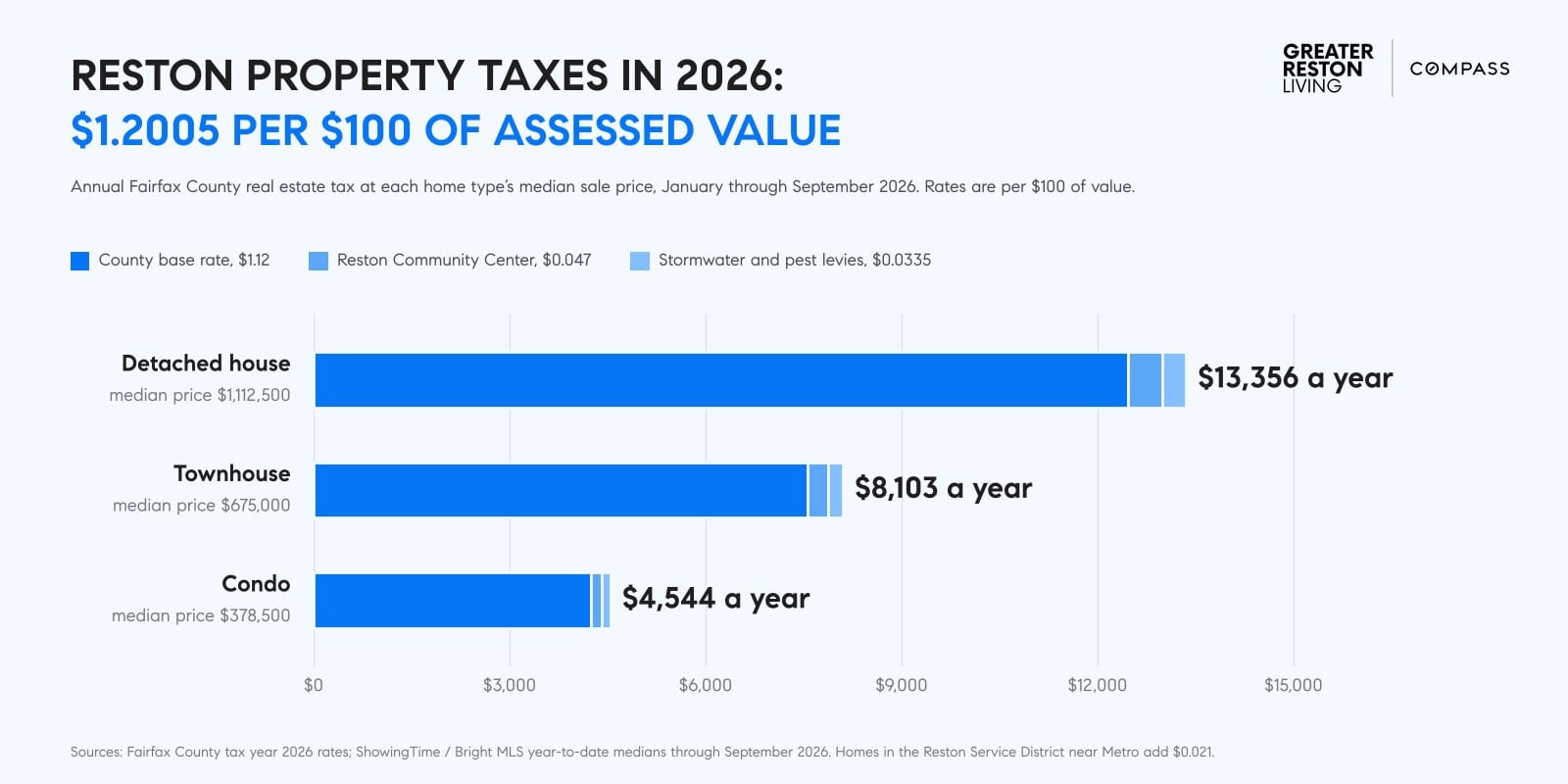
Fairfax County taxes a Reston home at $1.2005 per $100 of assessed value for 2026. At this year’s median sale prices, that comes to about $4,500 a year on a condo, $8,100 on a townhouse and $13,400 on a detached house. Homes near the Metro stations pay a little more.
Reston has no town government, so it has no town tax. Every dollar on a Reston homeowner’s real estate bill goes to Fairfax County, including a small levy that funds Reston Community Center. The Reston Association assessment, $890 for 2026, is a separate bill from a private association, and we cover it in our post on Reston Association fees.
Four county levies make up the $1.2005 rate
The Board of Supervisors set the 2026 rates when it adopted the FY2027 budget in May, and it trimmed the base rate from $1.1225 to $1.12. Fairfax County’s tax rate chart lists every levy. A typical Reston home pays four of them:
| Levy | Rate per $100 of assessed value |
|---|---|
| County base rate | $1.1200 |
| Reston Community Center | $0.0470 |
| Stormwater service district | $0.0325 |
| Pest infestation prevention | $0.0010 |
| Total for most Reston homes | $1.2005 |
| Reston Service District, homes near the three Metro stations | add $0.0210, for $1.2215 |
The county spends base-rate revenue on schools, police, fire and rescue, parks, libraries and the rest of the general fund. It spends the stormwater levy on drainage and stream restoration, and the pest levy on forest pest and mosquito control.
The county passes the Reston Community Center levy to Reston Community Center, which runs facilities at Hunters Woods and Lake Anne. Homeowners inside the tax district get discounted program rates and priority registration for RCC classes, trips and performances.
The Reston Service District adds 2.1 cents for homes inside the Reston Transit Station Areas around Wiehle-Reston East, Reston Town Center and Herndon station. The county uses that money to help build the new grid of streets planned around the stations. A condo at Reston Station or a townhouse near Reston Town Center will usually carry it. Most of Reston’s older neighborhoods do not.
A median Reston townhouse owes about $8,100 a year
Multiply the assessed value by the rate and divide by 100. For a $675,000 assessment at $1.2005, the annual tax comes to $8,103.
The table below runs that math at Reston’s median sale prices for the first nine months of 2026, from our September market report:
| Home type | Median sale price, Jan. to Sept. 2026 | Annual tax at $1.2005 | Annual tax at $1.2215 (near Metro) |
|---|---|---|---|
| Condo | $378,500 | $4,544 | $4,623 |
| Townhouse | $675,000 | $8,103 | $8,245 |
| Detached house | $1,112,500 | $13,356 | $13,589 |
| All homes | $639,900 | $7,682 | $7,816 |
The county taxes assessed value, which can sit above or below what a buyer pays. A home that sold this summer for well over its assessment will keep its old assessment until the county revalues it the following January, so a buyer’s first bill is often lower than the sale price suggests, and the second can jump. Look up any address in the county’s real estate assessment database to see its current assessed value and tax history.
The county raised residential assessments 3.99 percent for 2026
Fairfax County’s Department of Tax Administration values every home at 100 percent of its market value as of Jan. 1. For 2026, the department raised residential assessments by 3.99 percent on average through equalization, the yearly adjustment it makes to existing homes to keep their values in line with sales. Counting new construction, the residential tax base grew 4.31 percent, according to the county’s 2026 assessment announcement.
The countywide mean assessments for 2026:
- All residential: $829,895, up from $798,053
- Single-family detached: $1,012,504, up 4.28 percent
- Townhouse: $612,580, up 3.90 percent
- Condo: $387,560, up 2.94 percent
Even with the lower base rate, the county’s adopted budget summary projects the average residential tax bill rising $336.68 this year, because assessments rose faster than the rate fell.
Bills are due July 28 and Dec. 5
Fairfax County bills real estate tax in two halves, due July 28 and Dec. 5. When a due date falls on a weekend or holiday, the county moves it to the next business day, and it allows no grace period. Dec. 5, 2026 falls on a Saturday, so the second half is due the following Monday.
Assessment notices go out in February, and the 2026 notices went in the mail on Feb. 17. A notice shows the new value and asks for no payment. The county mails the bills three to four weeks before each due date.
Most Reston owners with a mortgage never see a paper bill. Lenders collect a share of the tax with each monthly payment, hold it in escrow and pay the county directly through its mass billing system, according to the county’s real estate tax FAQ. Owners without an escrow account pay the county themselves, online or by mail.
Owners can appeal an assessment by April 1
An owner who thinks the county overvalued a home can file an administrative appeal with the Department of Tax Administration. For 2026 the deadline was April 1. An owner who loses that appeal, or skips it, can go to the Board of Equalization, an appointed citizen board, by June 1. The county’s 2026 assessment guide recommends calling the department’s appraisers first, at 703-222-8234, and filing the administrative appeal before going to the board.
The strongest appeals rest on recent sales of similar homes nearby, or on a factual error in the county’s record, such as the wrong square footage or a bathroom count that never existed. For a Reston townhouse in a cluster with dozens of identical units, the county already has plenty of comparable sales, so an appeal usually needs a specific flaw in the house or the record to succeed.
Seniors, people with disabilities and disabled veterans can reduce or eliminate the bill
Fairfax County’s tax relief program covers homeowners 65 and older and people who are permanently and totally disabled. For 2026, a household qualifies with income up to $90,000 and net assets up to $400,000, not counting the home and up to one acre. The relief scales with income:
- Household income of $60,000 or less: 100 percent of the tax
- $60,001 to $70,000: 75 percent
- $70,001 to $80,000: 50 percent
- $80,001 to $90,000: 25 percent
Applications are due May 1. Reston Association also offers a reduced assessment to members enrolled in the county program, so a qualifying owner can lower both bills.
Veterans with a 100 percent service-connected, permanent and total disability rating from the VA pay no real estate tax on their principal residence, and the surviving spouse of a service member killed in action is also exempt on the home and up to one acre until remarriage, according to the county’s exemptions page.
Buyers and sellers split the year’s tax at closing
The county assesses each home for the full year in the name of whoever owns it on Jan. 1. At closing, the settlement attorney or title company prorates the year’s tax between buyer and seller by the closing date and collects what is owed out of the settlement, as the county explains in its payments FAQ. A buyer who closes in October on a Reston home usually receives a credit from the seller for the share of the December payment that covers the seller’s months.
Lenders also collect two to several months of taxes up front at closing to fund the new escrow account, which adds a few thousand dollars to a buyer’s closing costs on a typical Reston home.
The Town of Herndon adds 27 cents, and Loudoun’s base rate is lower
Homes inside the Town of Herndon pay everything a Fairfax County home pays plus the town’s own real estate tax of 27 cents per $100, which appears on the same county bill. On base rates alone, that puts a Town of Herndon home at $1.39 per $100 before district levies, against $1.12 in Reston. Herndon-address homes outside the town limits, in Franklin Farm, McNair or Oak Hill, pay the county rate only.
Loudoun County’s 2026 base rate is $0.805 per $100. On a $675,000 assessment, Loudoun’s base tax comes to about $5,434, against $8,103 for the full Reston rate, before Loudoun’s own district levies and HOA fees. Buyers comparing the two counties should also compare commute, school assignment and association costs.
Trash pickup and the car tax are separate bills
Fairfax County charges a $630 refuse fee only to the roughly 10 percent of households it serves directly with county trash collection. Most Reston homes use a private hauler instead, paid through the cluster or condo association’s fee or directly by the owner.
Fairfax County also taxes cars, trucks and other vehicles at $4.57 per $100 of assessed value each year, billed separately from real estate. Buyers moving from states without a car tax should budget for it.
Add the association bills to see the full yearly cost
For most Reston houses and townhouses, property tax is the largest yearly cost after the mortgage, and the association bills come next. For a $675,000 townhouse, $8,103 in county tax plus the $890 Reston Association assessment comes to $8,993 a year, before the cluster fee. Our guides to what it costs to own a home in Reston and the RA assessment, cluster fees and condo fees walk through the rest.
When we work with Reston buyers, we pull the county tax record and the association budgets for each home before an offer, so the monthly cost in the lender’s estimate matches what the owner will pay. Reach out to the Greater Reston Living team at Compass if you would like us to run those numbers on a home you are considering.
See something missing or wrong? Email us at [email protected] and we will check it and update the post.