
The Town of Herndon owns 10 license plate cameras. Over the 30 days ending Oct. 27, they recorded 324,273 unique vehicles, according to the Herndon Police Department’s public Flock dashboard. Officers ran 42 searches of that data in the same stretch, and the system raised 179 alerts on plates that matched lists of stolen cars, wanted people and missing children.
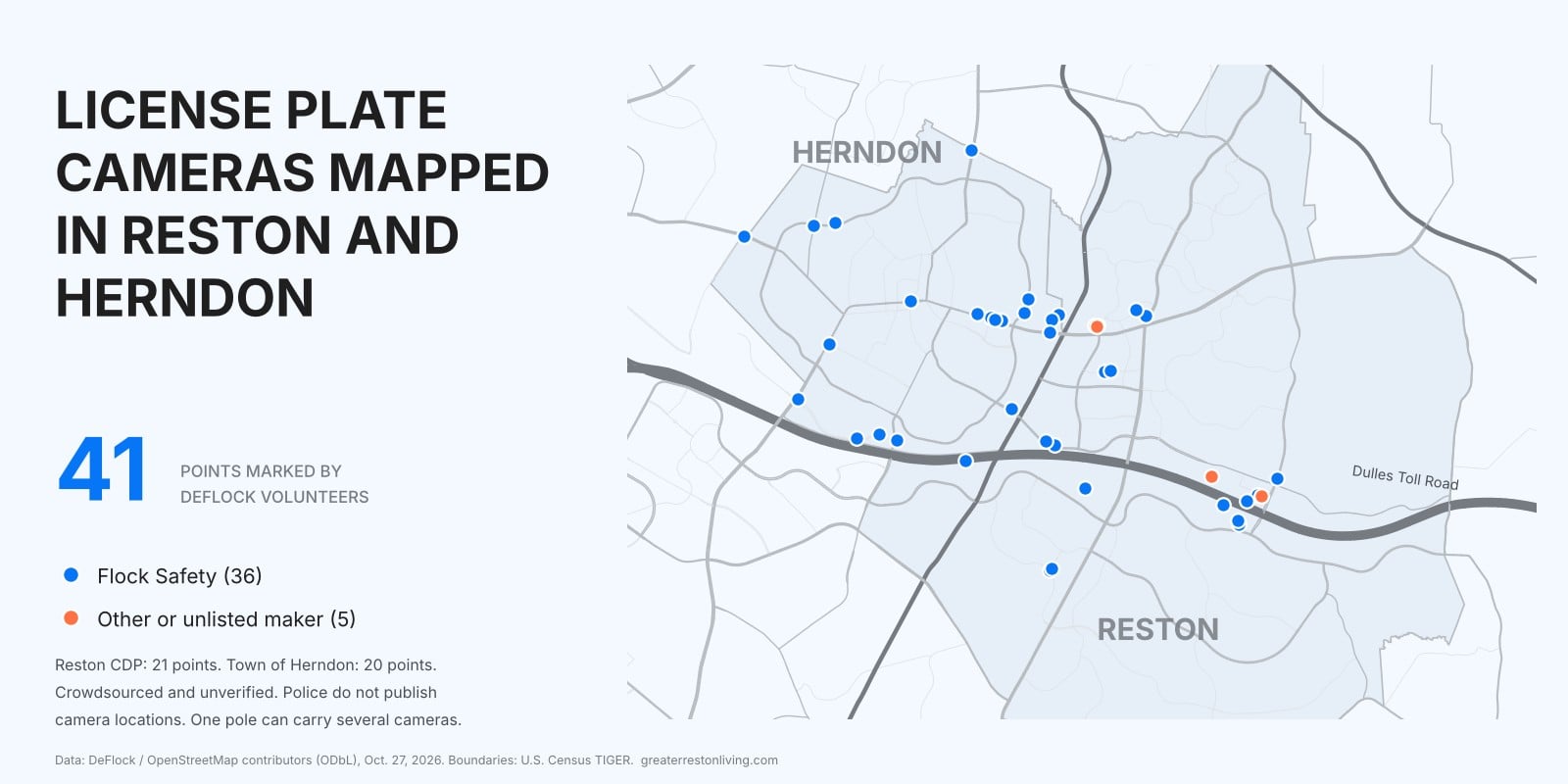
Fairfax County police run 84 more of the same cameras across the county, plus 712 readers mounted on cruisers, and they can tap into about 120 privately owned Flock cameras. Neither department publishes where its fixed cameras stand. Volunteers working with a project called DeFlock have mapped plate readers anyway, and their map shows 41 points inside Reston and the Town of Herndon.
Herndon elects six council members on Nov. 3, and two candidates have said they want the town out of its Flock contract. The Board of Supervisors stopped new county installations in September. A state senator is drafting a statewide ban for the General Assembly session that starts in January.
Our Oct. 21 post covered Supervisor Walter Alcorn’s call to end the county’s contract.
Volunteers have marked 21 camera points in Reston and 20 in Herndon
DeFlock is a crowdsourced map of license plate readers, built on OpenStreetMap, the free map anyone can edit. Volunteers add a point for each camera they spot, tag the maker when they can tell, and note which way it faces.
On Oct. 27, the map held 41 points inside Reston’s census boundary and the Herndon town limits. Thirty-six carry the Flock Safety name. Five list another maker or none at all.
In Herndon, eight of the 20 points sit on Elden Street or within a few steps of it, from the Fairfax County Parkway end to Alabama Drive past downtown. Others stand on Herndon Parkway, on Dranesville Road, near Worldgate Drive and on Spring Street.
Reston’s densest cluster surrounds Wiehle-Reston East. Eight of the 21 sit within a third of a mile of the station, on Wiehle Avenue at the Toll Road, along Reston Station Boulevard and Centennial Park Drive, and at a parking entrance on Sunset Hills Road. The rest spread out along Glade Drive at Pinecrest Road, Bowman Towne Drive, Reston Parkway near Baron Cameron Avenue, and Sunset Hills Road farther west.
Volunteers tagged one camera near Reston Parkway and Baron Cameron to The Home Depot, and the Sunset Hills parking entrance camera is a Verkada unit at a corporate garage. Three points on Cameron Pond Drive, a residential street in north Reston, list no maker or owner.
The Fairfax County Police Department’s Real Time Crime Center page says DeFlock’s entries come from users, are not verified by police, may count one camera more than once, and sometimes include equipment that is not a plate reader. Herndon’s own dashboard lists 10 cameras, and the map shows 20 points inside town limits. Some of the extras may be private or county cameras, some may be two cameras on one pole, and some may be mistakes.
Herndon’s cameras read 324,273 vehicles in 30 days, and officers searched 42 times
Herndon’s police department publishes more about its system than Fairfax County does, through a public dashboard hosted by Flock. As of Oct. 27 it showed:
- Cameras: 10
- Retention: 21 days, the maximum Virginia law allows
- Unique vehicles recorded, last 30 days: 324,273
- Searches by officers, last 30 days: 42
- Alerts on wanted vehicles, last 30 days: 179, drawn from the national crime database the Virginia State Police relays and from Amber Alerts
- Not detected: faces, people, gender or race
The dashboard lists immigration enforcement, traffic enforcement and personal use among the prohibited uses, and it says an officer must confirm every alert by eye before acting on it.
Herndon spent $15,000 to install the system on Oct. 16, 2023, and budgeted $38,000 for it in the current fiscal year under a computer maintenance line, FFXnow reported. The town bought it through a cooperative contract led by Henrico County, near Richmond. Henrico ended its own Flock contract on Oct. 6. A town police spokesperson told FFXnow that Henrico’s decision has no immediate effect on Herndon, and that the department takes direction from the Town Council.
Two Herndon council candidates on the Nov. 3 ballot want the contract gone
Twelve candidates are running for six Herndon Town Council seats on Nov. 3. Mayor Keven LeBlanc is running unopposed. The field includes five incumbents: Cesar del Aguila, Kelvin Garcia, Vice Mayor Clark Hedrick, Alex Reyes and Michael Lloyd. The challengers are Josif Ezekilov, Sabrina Bruce, Yasmin Shafiq, Meron Yohannes, Doug Mejia, Stevan Michael Porter and Justin Britt.
Ezekilov called the Flock deal “an egregious mistake” and told FFXnow he would push to end the contract “on day one.” Shafiq’s campaign site names Flock cameras as an example of technology that “should not compromise the rights of our residents.”
We found no stated Flock position from the other ten in their published profiles or in the Connection’s Herndon election guide. If you are a candidate and want your position added here, email us.
In April, the Herndon Friends Meeting, the Quaker congregation on Spring Street, asked Fairfax County police to stop using Flock.
Fairfax County has paused new cameras, and supervisors have no vote scheduled
The Board of Supervisors voted unanimously on Sept. 15 to stop installing new Flock cameras while it reviews the program. The 84 already in place kept running.
At the board’s Oct. 20 Safety and Security Committee meeting, police laid out three paths: keep Flock while reviewing other vendors, pilot other vendors, or move to a closed network the county controls. Supervisor Andres Jimenez asked about a fourth, no plate readers at all. Alcorn said he would vote to end the Flock contract, and his office cited two reasons in a statement that day: the vendor does not encrypt the data, and it does not manage the data on a private or closed network.
Supervisors are now sending written questions to county staff, who will answer them together, FFXnow reported. No vote is on the calendar.
The number of county employees who can search the data dropped from 821 to 296. Every search now requires a case number and a crime type, and an audit team reviews all of them, according to the department. Fairfax shares its plate data with 168 Virginia agencies and says it does not give federal or out-of-state agencies access without a court order.
The police case rests on stolen cars, arrests and one national study
From November 2022 through Oct. 12, Fairfax County police tied plate readers to 1,643 cases, 572 recovered stolen vehicles worth about $9.4 million, 937 arrests, 67 recovered guns and 60 missing people found. Those figures cover all three vendors the county has used, not Flock alone.
In November 2025, a reader on the 1600 block of Reston Parkway flagged a stolen Toyota Camry, and officers found it at a nearby shopping center and arrested a Centreville man after a short foot chase, FFXnow reported.
Maj. Hudson Bull of the department’s Real Time Crime Center told supervisors the readers have become “an essential law enforcement tool.” Supervisor Pat Herrity called them “incredibly effective.” Deputy County Executive Tom Arnold predicted crime would rise without them.
A working paper by Scott Mourtgos and Ian Adams compared 216 police agencies that adopted Flock with 3,108 that did not. Vehicle theft fell about 11 percent in the adopting agencies, and the share of crimes they solved rose about 16 percent. The authors note that solve rates were already climbing before the cameras went up, and they found no overall gain in recovering stolen vehicles. The paper has not been through peer review.
The privacy case rests on misuse, security and who else can search
In Kansas, a small-town police chief searched his ex-girlfriend’s plate 164 times and lost his law enforcement certification. The Washington Post counted more than 50 officers nationwide accused or convicted of misusing plate readers, ABC News reported. In Virginia, prosecutors charged a Chesterfield County investigator this month and a former James City County officer in September, WVTF reported.
In September, 404 Media reported that hackers pulled a Flock camera off its pole, copied its data and extracted its software.
Activists say Fairfax’s network of 168 Virginia agencies is wide enough that data can reach federal immigration authorities indirectly. Fairfax police say they do not use plate readers for immigration enforcement and do not share with federal agencies without a court order.
Arlington County voted Sept. 15 to remove its 41 cameras. Richmond will not renew when its contract ends next June. Henrico canceled on Oct. 6. Cardinal News counted at least 20 Virginia localities that paused, canceled or let contracts lapse since July.
Flock, based in Atlanta, responded in August with new safeguards: a seven-day default retention period for new customers, required two-step logins, automatic lockouts for unusual search activity, an outside security review, and a case code on every search by the end of the year. The Center for Democracy and Technology called the changes “Just Trust Us” with “a fresh coat of paint.”
DeFlock began as one engineer’s map, and a Fairfax group now campaigns under its name
Will Freeman, a software engineer, started DeFlock in October 2024 after he noticed the cameras on a drive, 404 Media reported. The map held about 1,700 U.S. cameras at launch and passed 135,000 nationally by August, according to the Salt Lake Tribune. Flock sent Freeman a cease-and-desist letter over the project’s name, and the Electronic Frontier Foundation refused it on his behalf on First Amendment grounds.
A local group, DeFlock Fairfax, campaigns in the county. Matthew Lofgren is its lead organizer, Annandale Today reported, and the group wants plate readers banned in the county, not swapped for another vendor. When the board paused new installs, DeFlock advocate Mia Amado called the move “performative.” Twelve organizations list themselves as supporters, among them Indivisible NOVA West, CASA, New Virginia Majority and the Herndon Friends Meeting.
The group backed the Fairfax County School Board’s Sept. 24 vote banning plate readers on school property, the Connection reported. No readers stood on school property when the board voted.
Virginia caps retention at 21 days, and a proposed ban would cover HOA cameras
Virginia’s plate reader law, Va. Code § 2.2-5517, took effect July 1, 2025. Police may search the data for a criminal investigation with reasonable suspicion, for a missing or endangered person, or for alerts on warrants and stolen vehicles. The data must be deleted after 21 days unless it belongs to a case. Agencies may not sell it or feed it into a federal, out-of-state, private or commercial database. An alert alone does not justify a traffic stop. Willful misuse is a Class 1 misdemeanor, the most serious misdemeanor class in Virginia. The data itself is exempt from the state’s public records law.
The law also requires each agency to report its use to the Virginia State Police, which compiles a statewide report. As of Oct. 27, the State Police lists that report as pending publication.
For the 2027 session, State Sen. Lashrecse Aird has drafted a statewide ban that would reach cameras owned by homeowners associations and businesses, NBC4 reported, and Republican Sen. Glen Sturtevant supports a ban. Gov. Abigail Spanberger opposes one and favors tighter rules. No bill had been filed as of Oct. 26, the Virginia Mercury reported.
Cluster and condo boards with cameras should check four things
Fairfax police can search about 120 private Flock cameras, and some of the points on the map sit on neighborhood streets. A Reston cluster or condo board that owns a plate reader, or is pricing one, can work through four questions:
- Who can search the footage. Owners decide whether to share with police and with which agencies. Ask the vendor for the current sharing list in writing.
- How long the vendor keeps the data. Virginia’s 21-day limit governs police data. Read the contract to see what applies to footage the association owns.
- What happens to the contract if Virginia bans the cameras. A multiyear agreement signed this winter could outlast a ban that takes effect next July.
- Whether residents know. A note in the board minutes and a line in the resale packet tell owners and buyers the camera is there.
Herndon’s Nov. 3 vote comes first, and the General Assembly follows in January
- Nov. 3: Herndon elects its Town Council.
- Nov. 5: The Virginia State Crime Commission, which took up plate reader data sharing in October, meets again.
- By year’s end: Flock’s case code on every search is due to apply to all customers. Fairfax already requires one.
- January: The General Assembly convenes, and Aird’s ban could be filed.
- No date yet: County staff answers to the supervisors’ questions, and any board vote on the contract.
See something missing or wrong? Email us at [email protected] and we will check it and update the post.