
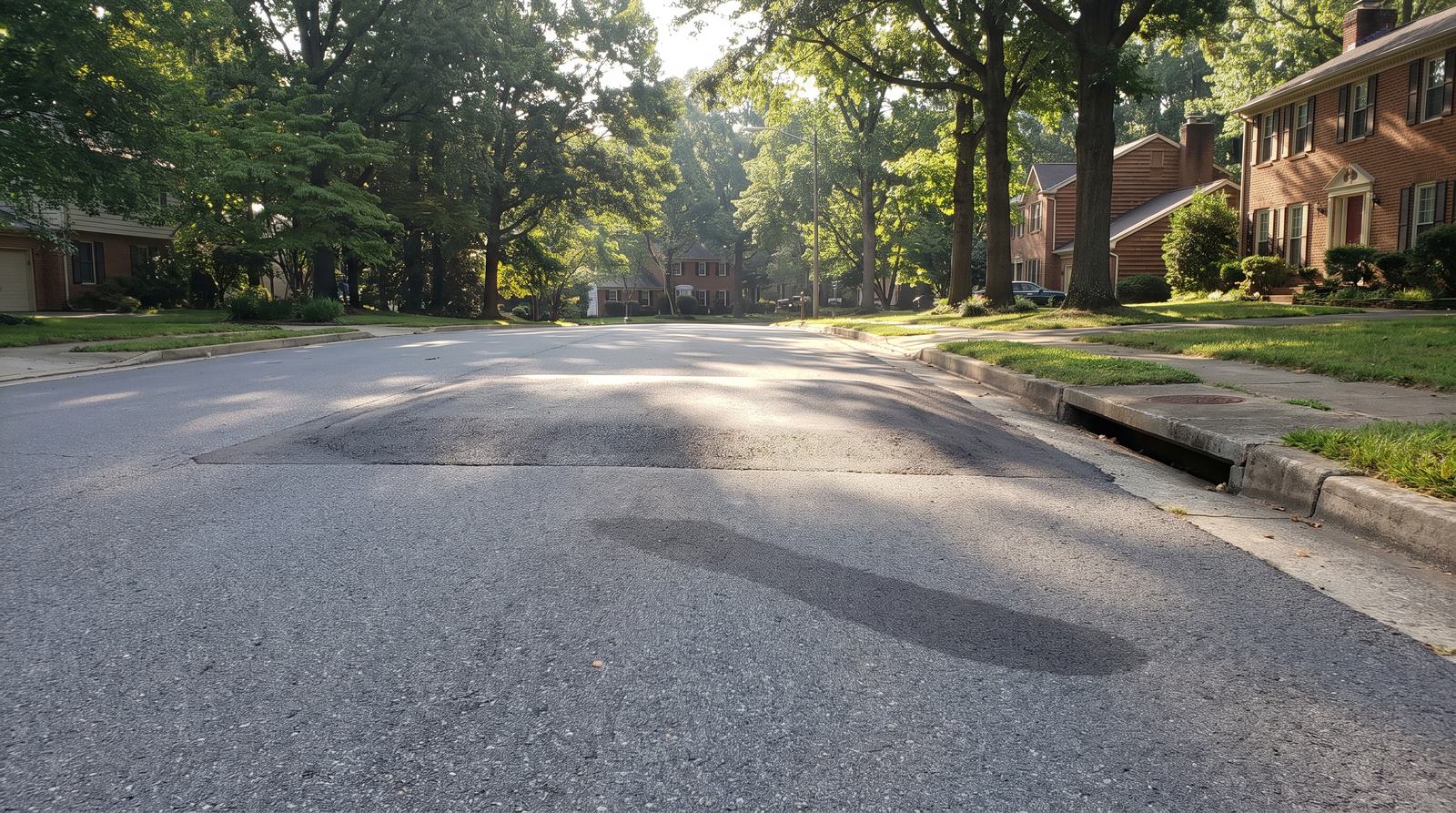
On August 25, the Fairfax County Board of Supervisors endorsed five new speed humps for two streets in the Hunter Mill District. Two go on John Milton Drive in Oak Hill, the unincorporated Herndon area around Fox Mill. Three go on Fairway Drive in Reston, off North Shore Drive. Both projects came out of the same county program, and both took months of organizing by neighbors before they ever reached a Board vote.
The complaint behind them comes up constantly at showings. A buyer stands at the end of a driveway, watches a car come through at what looks like double the speed limit, and asks whether anything can be done. In Fairfax County the answer is sometimes yes, and the path is far more structured than the request itself suggests.
This post walks that path end to end. What qualifies a street, what the speed study has to find, who is allowed to file the request, how the ballot works, and why the Fairway Drive vote was much closer than its reported margin makes it look.
What the Board approved on August 25
John Milton Drive gets two humps. One goes in adjacent to the Fox Mill Shopping Center, near 2572 and 2574 John Milton Drive. The second goes opposite Fox Mill Elementary School, between Thomas Young Lane and John Milton Court. County traffic studies measured average speeds of 36 mph eastbound and 34 mph westbound on a street posted at 25. The county’s announcement files both projects under Reston. John Milton Drive actually sits in Oak Hill, unincorporated Fairfax County with a Herndon mailing address, a few minutes over the Reston line.
Fairway Drive gets three humps. Two go across from Reston Association’s ballfields and tennis courts, and the third goes near Waterhaven Court. The Fairway humps will include cut-outs, gaps that let emergency vehicles pass through without slowing. The community asked for those specifically.
Both sets measure 12 feet wide and 3 inches high at the peak.
The Fairway speed study is the number worth sitting with. Across the 24-hour study period, 82 percent of drivers exceeded the 25 mph limit, and the study clocked 3.45 percent of vehicles above 55 mph. On a residential street running past ballfields.
Does the street qualify
Fairfax County runs neighborhood traffic requests through the Residential Traffic Administration Program, or RTAP. Traffic calming is the branch that installs physical devices, and FCDOT’s adopted operating procedures set out two rounds of screening.
Basic eligibility comes first. The street has to sit in the state system of highways owned and maintained by VDOT, be classified as a local, collector, or arterial road, function as a residential street, and carry a 25 mph speed limit. Streets posted at 30 or 35 fall out here, and so do private roads.
Then the traffic study has to confirm a problem. The street needs a volume between 500 and 6,000 vehicles per day, and a recorded 85th percentile speed of at least 35 mph in at least one direction.
Both ends of that volume range matter. Under 500 vehicles a day and the county judges the exposure too low. Over 6,000 and the road is doing arterial work, where humps create their own problems.
The 85th percentile does the most work here. It is the speed at or below which 85 percent of drivers are traveling, and engineers use it because it filters outliers at both ends. On a 25 mph street the reading has to hit 35, which is the same as saying at least 15 percent of drivers are doing 35 or better.
That is why a street can feel dangerous and still fail. A handful of drivers doing 50 will not move the 85th percentile if the bulk of traffic sits at 28. The test is built to catch streets where speeding is the pattern, not the exception. FCDOT also runs a preliminary field review at this stage for road grade, sight distance, drainage, and driveway locations, because a street can qualify on paper and still have no safe place to put a device.
If the street fails, the community can ask FCDOT for one additional study within the next two years.
Who is allowed to file the request
Getting this step wrong stalls the whole thing at the front door.
The request has to come from the neighborhood’s homeowners association or civic association. If the neighborhood has no association, it can come from either 10 residences or 10 percent of the residences along the street, whichever is less. Where an association exists, the district supervisor may still accept a request from that same 10-residence group.
One neighbor cannot start this alone.
The request itself has to name the street and its termini, meaning the two endpoints of the stretch under review, and supply contact information for roughly four or five residents willing to serve on a traffic calming task force, with one named as lead.
That task force then carries real work. Members inform the neighborhood, give FCDOT the community’s expectations before the conceptual plan gets drawn, review and approve that plan, collect signatures from every directly affected property owner, build support, distribute the ballots, and cover all costs of producing, distributing, and return-mailing them. The county does not pay for the ballots. The neighborhood does.
The plan, and the rules that shape it
Once a street qualifies, FCDOT drafts a conceptual plan and defines the ballot area. Several published constraints govern where devices can go.
Vertical devices, the category that includes speed humps, speed tables, speed cushions, and raised crosswalks, need a minimum of 400 feet between each other or between a device and a stop condition. Horizontal devices, such as bulb-outs, chicanes, chokers, raised medians, and lane-narrowing pavement markings, need 200 feet. Every device needs at least 150 feet of sight distance so drivers can see it in time. FCDOT can waive the spacing minimum for a single device on a short block or at a school or park entrance, case by case.
FCDOT then identifies directly affected properties, meaning any property with a device proposed directly adjacent to its boundary, and the task force has to obtain a concurrence signature from each of those owners.
After the signatures are in, the task force advertises a community-wide informational meeting to the entire ballot area at least two weeks ahead, by mail, newsletter, listserv, flyer, or road signage. If feedback at that meeting changes the plan, another meeting has to be held before any vote.
The ballot rule that decides everything
Here the program gets stricter than the headline numbers suggest.
The ballot area is not just the block getting the humps. It covers residences and businesses on the street itself plus residences and businesses on other streets whose sole or primary access runs through it, households that would be considerably inconvenienced by taking an alternate route.
One vote per occupied residence or business. Renters may vote in place of an absentee owner with association and supervisor approval. Vacant, bank-owned, and foreclosed properties count as unoccupied and drop out of the count entirely.
Then the threshold. More than 50 percent of the occupied residences and businesses in the ballot area must vote yes. Not a majority of ballots returned. A majority of everyone eligible.
Blank ballots and ballots marked twice count as no votes. Late ballots stay unopened. Task force members are barred from collecting and returning ballots on anyone’s behalf.
Run Fairway Drive through that rule. The county mailed ballots to 241 homes in April. By the June 13 deadline 161 came back, with 126 yes and 35 no. The reported margin was 78 percent to 21 percent, and 126 of 161 is indeed about 78 percent. But the number that decided it was 126 out of 241, which is 52.3 percent. Fairway cleared the bar by roughly two points, not fifty-seven.
The 80 households that never mailed a ballot back counted against the plan just as effectively as the 35 who voted no.
John Milton Drive passed 53 percent to 47 percent, three points clear of the 50 percent line.
A failed ballot locks the neighborhood out of the program for two years from the date voting closed. Which makes collecting returned ballots as much of the job as winning the argument.
What happens after the vote
The Board of Supervisors endorses the plan, which is the August 25 step for these two streets. The resolution and plan then go to VDOT, and once VDOT reviews and confirms, FCDOT schedules installation. The county expects that within the coming weeks for John Milton and Fairway.
Devices are not permanent by default, but they are close. A neighborhood has to wait two years after installation before requesting a modification or removal, and between years two and five a removal or modification request needs either the association or a petition signed by more than half the residences along the road.
Why the speed reduction is the point
The county cites Insurance Institute for Highway Safety research on pedestrian outcomes: roughly an 18 percent risk of severe injury or death at 20 mph, about 50 percent at 30, and about 81 percent at 40. Lower speeds also widen a driver’s field of vision and shorten stopping distance, while higher speeds narrow peripheral focus.
Fairfax County has local evidence too. Two humps installed earlier on the eastern portion of Fairway Drive, between Beaver Circle and Shagbark Circle, cut speeds by 10 to 12 percent, and the follow-up study recorded zero vehicles at 55 mph or above on that stretch.
When humps are off the table, look at the other four programs
Traffic calming is one of five RTAP programs, and the current programs chart lays out the rest.
“$200 Additional Fine for Speeding” signs mount under existing speed limit signs. They need a local, collector, or minor arterial road posted at 35 mph or less, at least 600 vehicles per day, and an 85th percentile at least 10 mph over the limit. The speed test matches traffic calming, so this is not a fallback for a street that fails the speed study. It is the option for a street that fails on the other criteria: one posted at 30 or 35 rather than 25, or one carrying more than the 6,000 vehicles per day that disqualifies a street from humps.
Cut-through mitigation attacks volume rather than speed, using access restrictions or route changes. It needs a local residential street posted at 25 mph, at least 150 cut-through trips in one hour in one direction, and cut-through traffic making up 40 percent or more of that hour’s single-direction volume. The sequence runs longer than traffic calming, with a joint FCDOT and VDOT public meeting after the community vote and before the Board resolution.
“Watch for Children” signs require no traffic study. FCDOT reviews the neighborhood for eligible locations, which are limited to community entrances, playgrounds, daycares, community centers, and similar points of concern.
Through-truck restrictions keep trucks without local stops off the road. The street has to be a local or collector road in a residential neighborhood, or a minor arterial or primary road with at least 12 dwellings per 1,000 feet, and a safety concern has to indicate the need. VDOT runs its own engineering review and public comment period before deciding.
If the address is inside the Town of Herndon, none of this applies
Worth knowing before anyone spends a season on paperwork. RTAP requires the street to sit in the state system maintained by VDOT. The Town of Herndon maintains its own streets through its Public Works department, as incorporated towns in Virginia’s urban system do. Streets inside the town limits are not county streets, so traffic requests there go to the town rather than to a county supervisor.
Outside the town limits, Herndon-addressed neighborhoods are county territory and RTAP applies normally. Oak Hill is the example on this page. John Milton Drive carries a Herndon mailing address, sits outside the town, and ran through the county program under the Hunter Mill District. Herndon and Oak Hill addresses do not all land in the same district, so confirm yours before sending anything.
What this means if you are buying
Traffic is one of the few things about a house a buyer can assess better than any listing can describe.
Visit at the hours that matter. A street beside Fox Mill Elementary behaves one way at 10 a.m. Saturday and another at 8:15 Tuesday. Sit in the car through a drop-off and an evening peak before deciding what the street is.
Read the devices already in place. Existing humps, “$200 Additional Fine” placards, and “Watch for Children” signs each mean the neighborhood ran this gauntlet at some point, which tells you the traffic was measurably bad and that the neighbors could organize. Both are useful facts about a place.
Ask what is pending. A street with an endorsed plan awaiting VDOT review is about to change, and John Milton and Fairway sit in exactly that window right now.
Understand the ceiling. A street carrying more than 6,000 vehicles a day cannot get humps under the current criteria at all. That is a fact about the road rather than a place in a queue, and it belongs in what the house is worth to you. Our guide to which high school a Reston or Herndon address feeds covers the other question that turns on exactly where a line falls.
What this means if you are selling
Buyers find traffic problems on their own, and the ones who care will care regardless of how the listing reads.
What helps is having accurate answers ready. If humps are endorsed and awaiting installation, say so and link the county page. If a ballot failed, that is a fair question to answer plainly, including the two-year wait before the neighborhood can try again. If the street already has devices and the follow-up study showed speeds dropped, that is a straightforward positive, and Fairway’s eastern section is a documented local example.
The version that costs money is a vague reassurance that gets contradicted in week three of the contract. Specifics hold up.
How to start
For Reston, contact Supervisor Walter Alcorn’s Hunter Mill District office at 1801 Cameron Glen Drive, or 703-478-0283. John Milton Drive ran through that same office. Other Herndon and Oak Hill addresses outside the town limits do not all fall in Hunter Mill, so confirm your district first. Inside the town, start with the Town of Herndon.
Two things make a request stronger. Bring the association, or the 10 residences, because a request from one household does not meet the program’s entry requirement. And be specific about location and timing, since “eastbound between the shopping center and the school, weekday mornings” gives FCDOT something to study in a way that “people speed here” does not.
Then plan on patience. Fairway Drive’s ballots went out in April and the Board endorsed the plan on August 25, and that came after the eligibility screen, the speed study, the conceptual plan, the adjacent-owner signatures, and the community meeting. Installation waits on VDOT. The neighbors on both streets started the conversation well before any of it.
We sell homes across Reston, Herndon, and the rest of Northern Virginia, and questions about traffic, schools, and what a street is like at 5 p.m. come up in nearly every search. If you are weighing a move and want a straight read on a specific block, reach out and we will walk it with you.