

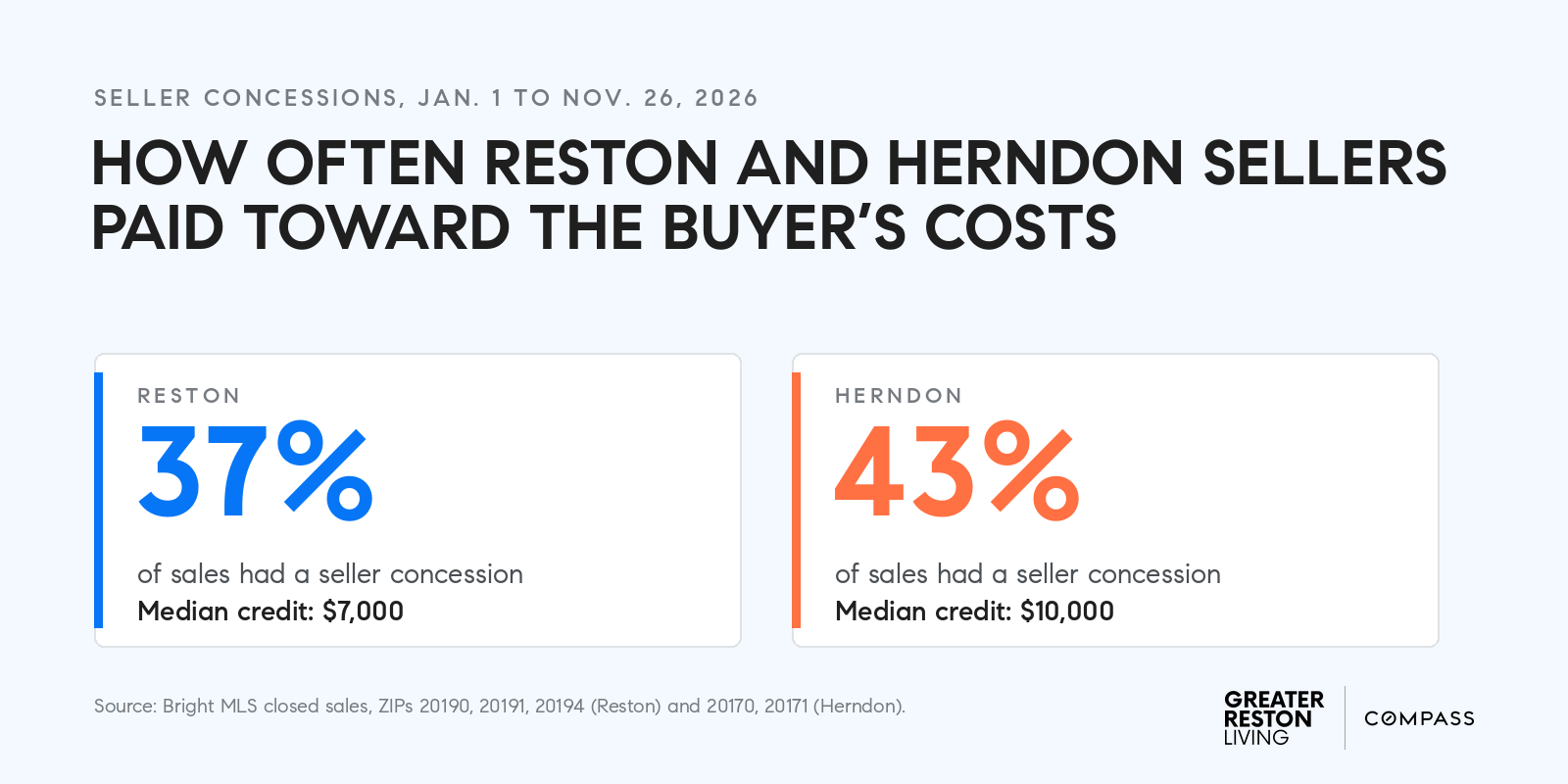
Reston sellers gave the buyer a concession in 37 percent of the home sales that closed between Jan. 1 and Nov. 26, 2026. When they did, the median credit came to $7,000. Herndon sellers gave one in 43 percent of sales, with a median of $10,000. Those figures come from the concession amounts recorded in Bright MLS for 1,691 closings across the two markets.
A concession is money the seller agrees to put toward the buyer’s costs at settlement: closing costs, discount points, a rate buydown, prepaid taxes and insurance, or a repair credit in place of fixing something before closing. The sale price in the public record stays the same, and the credit comes out of the seller’s proceeds.
Our earlier post worked through the math of a price cut, a closing cost credit and a rate buydown on the same $15,000. Below are the 2026 numbers by home type, the two contract lines a concession can sit on, the limit each loan type sets, and the effect a credit has on the next appraisal on your street.
Herndon townhouse sellers gave credits most often, and Reston condo sellers gave the smallest ones
By home type, for sales that closed from Jan. 1 through Nov. 26:
| Home type | Reston: sales with a concession | Reston: median credit | Herndon: sales with a concession | Herndon: median credit |
|---|---|---|---|---|
| Condos | 44% | $5,000 | 48% | $6,340 |
| Townhouses | 33% | $10,000 | 53% | $11,600 |
| Detached houses | 32% | $10,000 | 36% | $10,000 |
| All homes | 37% | $7,000 | 43% | $10,000 |
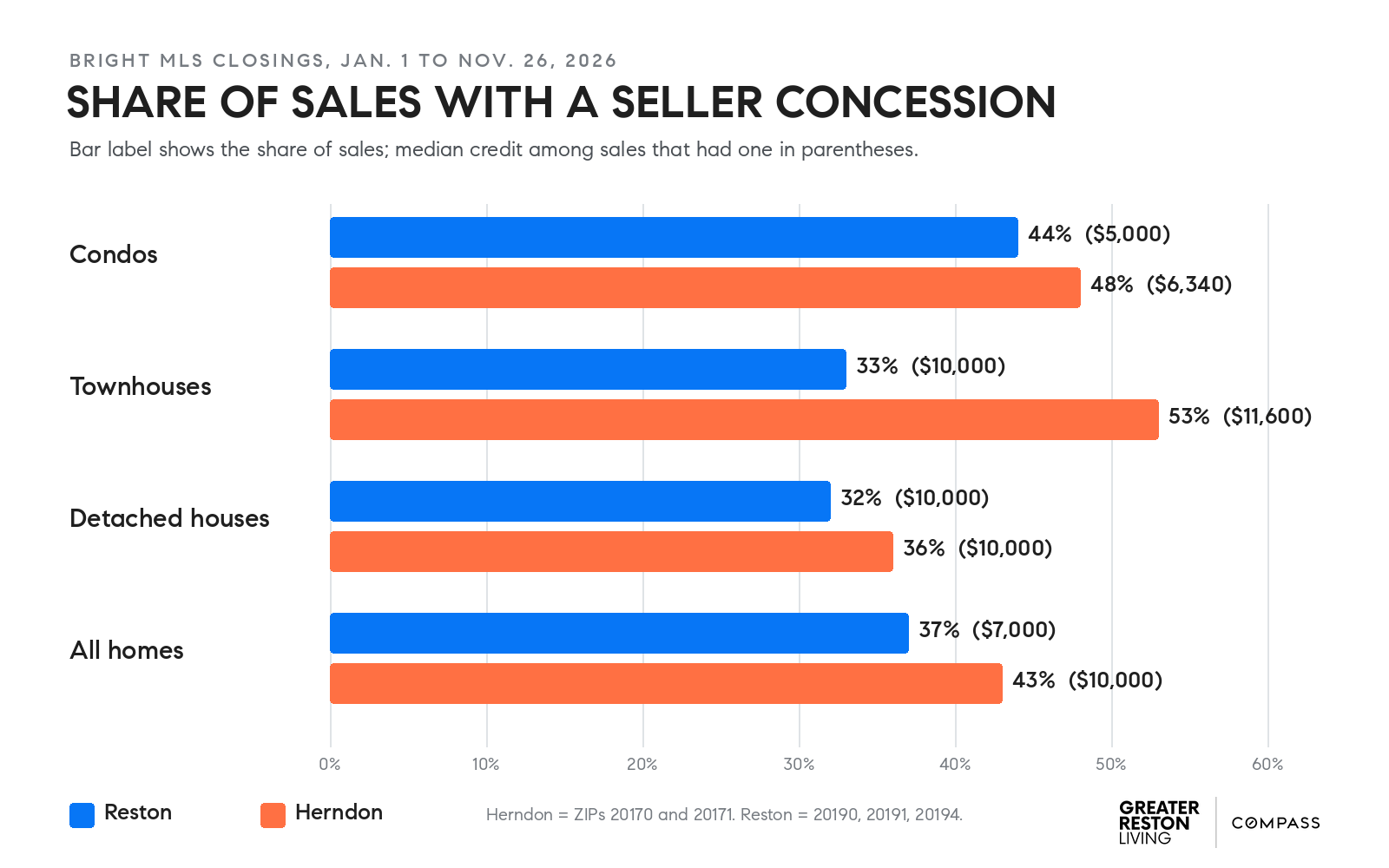
The median Reston credit came to 1.35 percent of the sale price, and the median Herndon credit to 1.46 percent. Herndon townhouses ran highest, at a median of 2.1 percent. Herndon here means both of its ZIP codes, 20170 and 20171, which take in the Town of Herndon, Oak Hill and the Dranesville area.
Across both markets, sellers gave a concession on 58 percent of the sales financed with FHA loans, 49 percent of the VA sales and 42 percent of the conventional sales. Cash buyers got one 22 percent of the time.
Some sellers cut the price and gave a credit too. The original list price is the price on a listing’s first day, before any reductions. In Reston, 18 percent of 2026 sales closed below their original list price and still carried a concession. In Herndon, 24 percent did. Measured on price alone, 55 percent of Reston condos and 69 percent of Herndon condos sold below their original list price between Jan. 1 and Nov. 9, up from 35 and 41 percent over the same stretch of 2024.
Redfin reported that sellers in the Washington, D.C., metro gave concessions in 44 percent of the sales its agents handled in the three months through August, up 4.2 percentage points from a year earlier. Our reports on townhouse and condo competition in Reston and the October Reston market track the rising supply behind those numbers.
A Northern Virginia sales contract puts concessions on two separate lines
The standard residential sales contract from the Northern Virginia Association of Realtors lists two kinds of seller money in paragraph 2. Line 2D, “Seller Subsidy,” is a payment toward the buyer’s charges. The contract defines those charges to include loan origination fees, discount points, buydown fees and prepaid items, as far as the buyer’s lender allows. Line 2E is the seller’s payment toward the buyer’s own agent. Both lines reduce what the seller nets at settlement.
NVAR added line 2E on July 1, 2024, about seven weeks before the national commission settlement took offers of buyer-agent pay off the MLS. Before then, a listing broker usually shared its commission with the buyer’s broker, and the offer of that payment sat in the MLS listing rather than in the sales contract. Now a buyer can ask for it in the offer, the same way the buyer asks for help with closing costs.
Fannie Mae and Freddie Mac confirmed in April 2024 that a seller’s payment to the buyer’s agent does not count toward their concession limits. FHA said the same for its loans, VA changed its rules that year so a veteran could pay a buyer’s agent directly while leaving seller-paid commissions outside its cap, and USDA exempted commissions from its 6 percent cap in May 2024. A seller can fund line 2E and still give the buyer the full subsidy the loan allows on line 2D.
The buyer’s loan type and down payment set the ceiling on line 2D
Each loan program caps interested party contributions, the lending term for money that the seller, a builder or an agent puts toward the buyer’s costs. On a $675,000 purchase, the median price of a Reston townhouse sold this year:
| Loan | Down payment | Seller contribution limit | On a $675,000 purchase |
|---|---|---|---|
| Conventional, primary home or second home | Less than 10 percent | 3 percent | $20,250 |
| Conventional, primary home or second home | 10 to 24.99 percent | 6 percent | $40,500 |
| Conventional, primary home or second home | 25 percent or more | 9 percent | $60,750 |
| Conventional, investment property | Any | 2 percent | $13,500 |
| FHA | 3.5 percent minimum | 6 percent | $40,500 |
| VA | Any | 4 percent, with normal closing costs outside the cap | $27,000, plus closing costs |
The conventional tiers come from Fannie Mae’s Selling Guide, which sets them by combined loan-to-value ratio, the total of all loans on the home as a share of its value. A buyer with a second loan can land in a lower tier. FHA’s 6 percent and VA’s 4 percent are each agency’s own limit. VA counts items such as a seller-paid funding fee, prepaid homeowners insurance or payoff of the buyer’s debts against its 4 percent, while ordinary loan costs stay outside it. Loans above Fairfax County’s 2026 conforming limit of $1,249,125 follow each jumbo lender’s own rules.
The money can pay closing costs, points and prepaid items, but Fannie Mae does not allow it to cover the down payment or the cash reserves a lender requires. Fannie Mae figures its percentage on the lower of the sales price and the appraised value, and VA figures its 4 percent on the appraised value, so a low appraisal shrinks the ceiling. Fannie Mae treats any contribution above its limit as a cut in the sales price. The NVAR contract adds its own rule: if the lender will not allow part of the subsidy, the subsidy drops to the amount the lender allows.
Under that clause, a buyer who negotiates a $20,000 subsidy but has $14,000 in charges the lender will let the seller pay gets $14,000. The other $6,000 stays with the seller. Buyers should get a lender’s estimate of total allowable charges before writing the number into an offer. Sellers reading an offer can check the loan type in line 2C and the down payment in line 2B and work out the buyer’s ceiling before responding.
A seller credit stays with the sale when the next appraiser pulls comparables
Appraisers who use Bright MLS can see the concession amounts agents enter on closed sales. Fannie Mae requires appraisers to report the dollar amount of concessions on each comparable sale when the figure is reasonably available, and to adjust the comparable for the effect of those concessions on its price. In its December 2023 appraiser update, Fannie Mae reported that appraisers made no adjustment on 58 percent of comparables with reported concessions. When they did adjust, they took the concession off dollar for dollar 86 percent of the time.
For a seller, that means a $700,000 sale with a $20,000 credit can read as low as $680,000 to the appraiser valuing the house next door. A credit keeps the price on your own listing intact. It does not keep that price in your neighbors’ comparables.
Appraisals also limit the “raise the price, credit it back” offer, where a buyer offers more than the asking price in exchange for a larger credit. The structure works only if the appraisal supports the higher price. If the appraisal comes in lower, the lender sizes the loan off the lower number, and on a conventional or VA loan the concession limit drops with it. Our price reduction post walks through a low appraisal step by step.
NVAR’s escalation addendum, the form a buyer uses to raise an offer automatically above competing bids, defines “Net” as the sales price minus all seller concessions and payments toward the buyer’s agent, so a higher price with a large subsidy can lose to a lower offer with none.
Fairfax County deed taxes cost each side about $2,000, and the regional fees can move to the buyer
A subsidy can go toward the taxes and prepaid items due at settlement. Under the Fairfax County Circuit Court’s fee schedule, which covers Reston and Herndon, a $675,000 deed carries these charges:
- Buyer: state recordation tax of 25 cents per $100 and county recordation tax of 8.3 cents per $100, about $2,248.
- Seller: grantor tax of 10 cents per $100, plus a regional congestion relief fee and a regional WMATA capital fee of 10 cents per $100 each, about $2,025.
A buyer with a loan also pays the state and county recordation taxes on the amount borrowed, at the same rates. With 20 percent down on that $675,000 home, the $540,000 loan adds about $1,798.
Since July 2020, Virginia law has let buyer and seller agree that the buyer pays some or all of the congestion relief fee and the WMATA fee. On a $675,000 sale, those two fees come to $1,350. A seller in a strong segment can ask the buyer to take them on, a concession running the other direction.
Prepaid items count toward line 2D too. At Fairfax County’s 2026 base real estate tax rate of $1.12 per $100, a year of tax on a home assessed at $675,000 comes to $7,560, before the countywide stormwater levy and any Reston or Town of Herndon levy. The lender collects part of that into the buyer’s escrow account at settlement, along with homeowners insurance and interest for the rest of the month. The property tax guide breaks down a Reston tax bill line by line.
Seller-paid points carry a tax rule for buyer and seller
Freddie Mac’s 30-year fixed rate averaged 7.21 percent for the week of Nov. 25, up from 6.23 percent a year earlier. A buyer can take the subsidy as discount points, prepaid interest that lowers the rate for the life of the loan.
The IRS treats points the seller pays as if the buyer paid them, which can make them deductible for the buyer, provided the buyer subtracts them from the home’s cost basis. The seller cannot deduct them but counts them as a selling expense that reduces the gain on the sale. A tax preparer can confirm how that applies to your return.
Settle three numbers before the first offer arrives
- Your segment’s leverage. In 2026, 32 percent of Reston detached sales carried a concession, against 53 percent of Herndon townhouse sales. Compare your home with the active and recently sold homes of the same type in your building or cluster, including their price cuts and credits.
- The buyer’s ceiling. The loan type and down payment in paragraph 2 of the offer tell you the most the lender will let you contribute. Under the contract, any amount above that figure drops off at settlement even if you agreed to it.
- Your net, across every line. Lines 2D and 2E both come out of your proceeds. Compare offers on what you take home after both, the same way the escalation addendum does.
If you are planning a sale in Reston or Herndon and want to see how much negotiating room homes like yours have needed this year, reach out. We can pull the recent sales and credits in your segment and build a net sheet before you list.
See something missing or wrong? Email us at [email protected] and we will check it and update the post.