
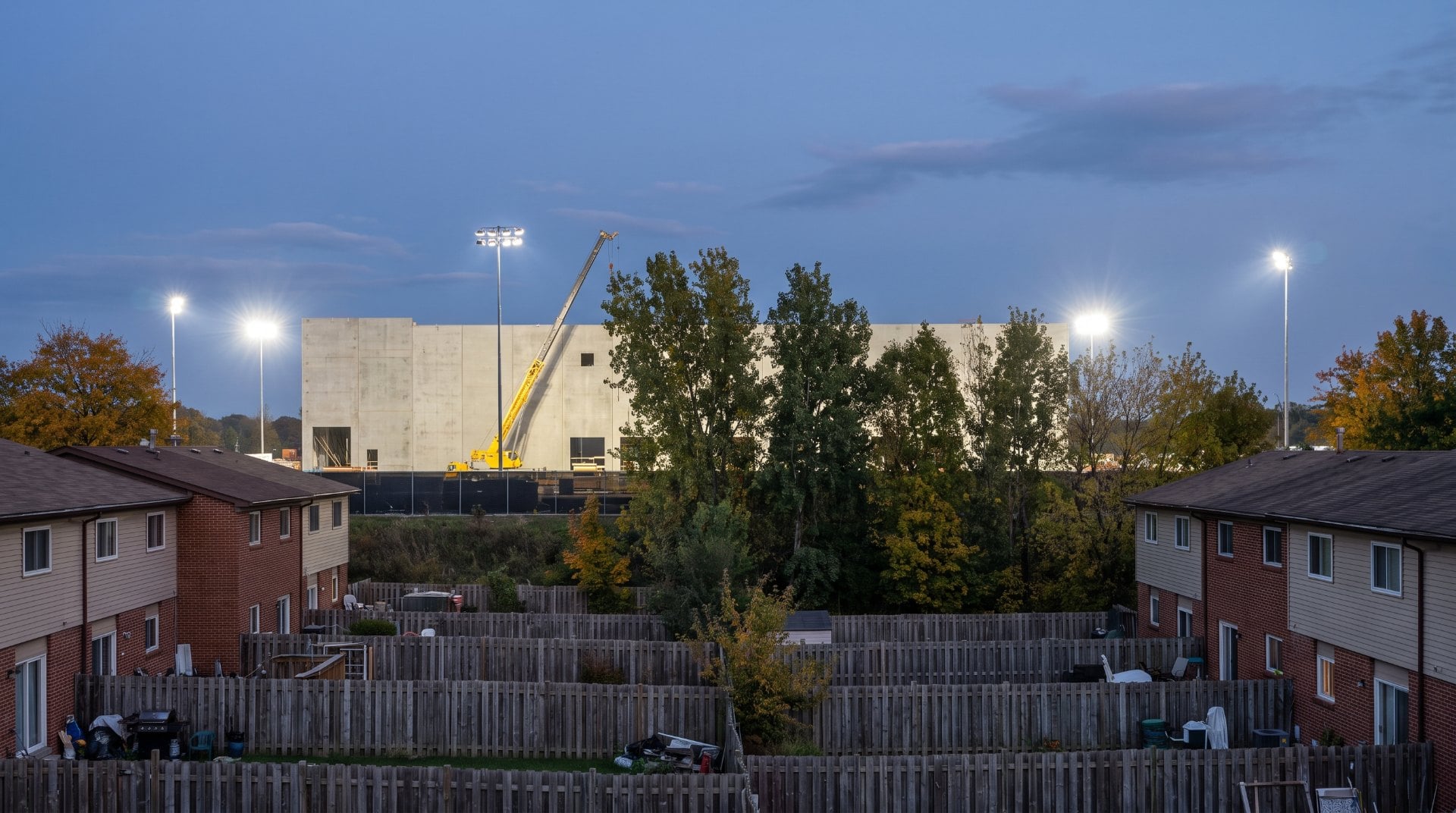
A three-story data center is rising on the south side of Sunrise Valley Drive in Reston, just east of the Fairfax County Parkway, and the Cocquina Cluster homes sit directly behind it. This week WUSA9 reported that neighbors on Cocquina Drive are living with constant drilling, banging, and bright lights at night, and that the building, roughly 75 feet tall, now towers over their backyards. Residents told the station the site comes within 100 feet of some homes.
On September 30, a week before that report, the data center’s owner filed a request with Fairfax County to change the screening between the building and those same homes. CoreSite wants the county to accept different landscaping in the buffer along its southern property line because the approved plantings didn’t take hold.
County staff will decide that request without a public hearing, most likely by early December. Neighbors can still put their views on the record before then.
CoreSite says the approved plantings failed and wants to substitute new ones
The filing, record INTZED-2026-HM-00062 in the county’s PLUS permitting portal, requests a determination of substantial conformance. That is the county’s term for a ruling on whether a change to an approved project is small enough to stay within the original approval.
The subject is the transitional screening yard, a strip of land the zoning ordinance requires between an industrial use and the homes next to it, planted and fenced to block the view. CoreSite’s request covers the yard along the southern boundary of its campus at 12369 Sunrise Valley Drive, the side that faces the Cocquina Cluster.
According to the project description on the county record, CoreSite:
- Asks for approval of “alternative landscape and screening improvements” because of “documented difficulties establishing previously approved plantings within the buffer area”
- Cites mature tree canopy, soil limitations, and “residential encroachments” as the site conditions behind the change
- Proposes adding understory trees, the smaller trees that grow beneath a forest canopy, wherever they can be planted, along with updated landscaping
- Says the existing mature vegetation, a six-foot wood fence, and a ten-foot opaque security fence will all stay
- Says it is not changing the approved data center buildings or the rest of the site plan
The filing does not define “residential encroachments.” In zoning practice, the phrase usually means sheds, fences, play equipment, or yard use that crosses from a neighboring lot onto the other owner’s land.
A 2018 rezoning approved the whole campus, so the expansion needs no new vote
CoreSite bought the former Sunrise Technology Park, four office buildings from the 1980s on about 21.7 acres, from Brookfield in 2016 for $60 million. The Fairfax County Board of Supervisors rezoned the site on August 13, 2018, under rezoning RZ-2017-HM-032 and a companion special exception, SE-2017-HM-030. That approval allows about 943,600 square feet of data center space on the campus, built in four phases.
The first phase converted two of the old office buildings into data centers and added a new two-story building in 2019. The second phase is the building now under construction behind Cocquina Drive. FFXnow reported in July 2025 that the site plan, county record SP-2024-00054, shows a three-story building of about 215,000 square feet and roughly 75 feet tall, replacing a one-story office building that stood about 19 feet. CoreSite plans two more three-story data centers for the third and fourth phases.
Across the street, CoreSite has operated its VA1 and VA2 data centers at 12100 Sunrise Valley Drive since 2008, on a property that previously belonged to AOL. With all four phases of the south campus built, CoreSite would have about 1.3 million square feet of data center space on the two sides of Sunrise Valley Drive.
Because the Board approved the development plan in 2018, each phase moves forward through staff-level site plan and permit reviews. Phase two includes no new public hearing, and the screening request also requires none.
The county’s 2024 data center rules do not reach this project
On September 10, 2024, the Board of Supervisors adopted new data center zoning rules. Under them, a new data center building must sit at least 200 feet from the lot line of a residential district, and backup generators and similar equipment at least 300 feet. Applicants must also submit noise studies before and after construction, and enclose or screen equipment with a wall.
Those rules apply to new applications. Supervisor Walter Alcorn’s office confirmed to FFXnow in 2025 that projects approved before the amendment, including CoreSite’s, are not subject to them. Residents told WUSA9 the construction site comes within 100 feet of some homes. A data center building approved under today’s rules would have to stay at least 200 feet from a residential district’s lot line.
Neighbors raised concerns in 2025, before construction began
The first round of objections came in June 2025, when CoreSite’s engineering firm, Langan, mailed notice of the phase two site plan to some neighbors. Cocquina Cluster Homeowners Association President Maggie Urbanik told FFXnow that only a handful of homeowners received the letter, that she did not receive one, and that the letter listed an address and location across Sunrise Valley Drive rather than the lot directly behind the cluster. Residents also raised the building’s height and its effects on noise, traffic, night lighting and the steam from the campus’s evaporative cooling.
CoreSite’s Mid-Atlantic general manager, Chris Lettiere, told FFXnow at the time that the company was working closely with the county on permitting and following all ordinances. He said the expansion would create about 300 construction jobs and 50 permanent jobs.
The site plan has since moved forward and construction is under way. The complaints WUSA9 reported this week concern day-to-day construction: noise, vibration and floodlights at night.
Fairfax County allows construction noise from 7 a.m. to 9 p.m. on weekdays
The county’s noise ordinance sets the hours for construction work:
- Monday through Friday, 7 a.m. to 9 p.m.
- Weekends and federal holidays, 9 a.m. to 9 p.m.
In residential areas, construction noise is limited to 90 decibels at the property line, which the county compares to standing next to a gas-powered lawn mower. Complaints about construction noise go to the Department of Code Compliance, online through PLUS or by phone at 703-324-1300. The department schedules an inspection within a few days. It does not respond in the moment.
The noise ordinance does not set a standard for construction lighting. Neighbors concerned about floodlights can raise them with Supervisor Alcorn’s office and ask whether the approved site plan includes conditions on temporary lighting.
County staff targets a decision by early December, with no hearing
Under the county’s interpretation process, the Zoning Administrator decides whether a change is in substantial conformance and has delegated that job to the director of the Zoning Evaluation Division. No public hearing takes place. The county targets 30 business days for a simple request and 45 for a complex one, which puts a decision on CoreSite’s September 30 filing somewhere between mid-November and early December.
If staff finds the change goes beyond a minor modification, CoreSite would need to amend its zoning approval, and an amendment does go to public hearings.
The interpretation page does not describe a formal comment period. Neighbors who want their views on the record can:
- Write to the Zoning Evaluation Division and cite record INTZED-2026-HM-00062 and the original case, RZ-2017-HM-032
- Contact Supervisor Alcorn’s Hunter Mill District office, which has handled resident questions about this project before
- Ask for a copy of the approved landscape plan and the proposed replacement, so the comparison rests on drawings rather than a summary
- Report noise outside the permitted hours to the Department of Code Compliance with dates and times
Buyers near Sunrise Valley Drive should read the zoning next door
For owners in the Cocquina Cluster, the buffer will be a 75-foot wall between their back windows and the street once construction ends. A thicker planting of understory trees ahead of the 10-foot security fence would also soften the view. A thinner one would not. Owners thinking about selling in the next year or two will want to see what the county approves before they list, and to photograph the yard in daylight and after dark once construction ends.
Office parks line much of Sunrise Valley Drive between Reston Station and the Fairfax County Parkway. Where an owner already holds a zoning approval, as CoreSite does, a much larger building can follow years later without another vote. We wrote about a similar setup near Herndon’s new Skyview High School, and about the county’s study of the office parks west of Wiehle Avenue. Before buying a home that backs up to commercial land:
- Look up the neighboring parcel in PLUS and read the most recent zoning case and site plan
- Visit at night as well as during the day, and on a weekday morning when construction or deliveries start
- Ask the HOA whether the neighboring owner has notified residents of any pending plans
We will update this post when the county rules on CoreSite’s request, and when the third phase of the campus reaches a site plan.
See something missing or wrong? Email us at [email protected] and we will check it and update the post.