

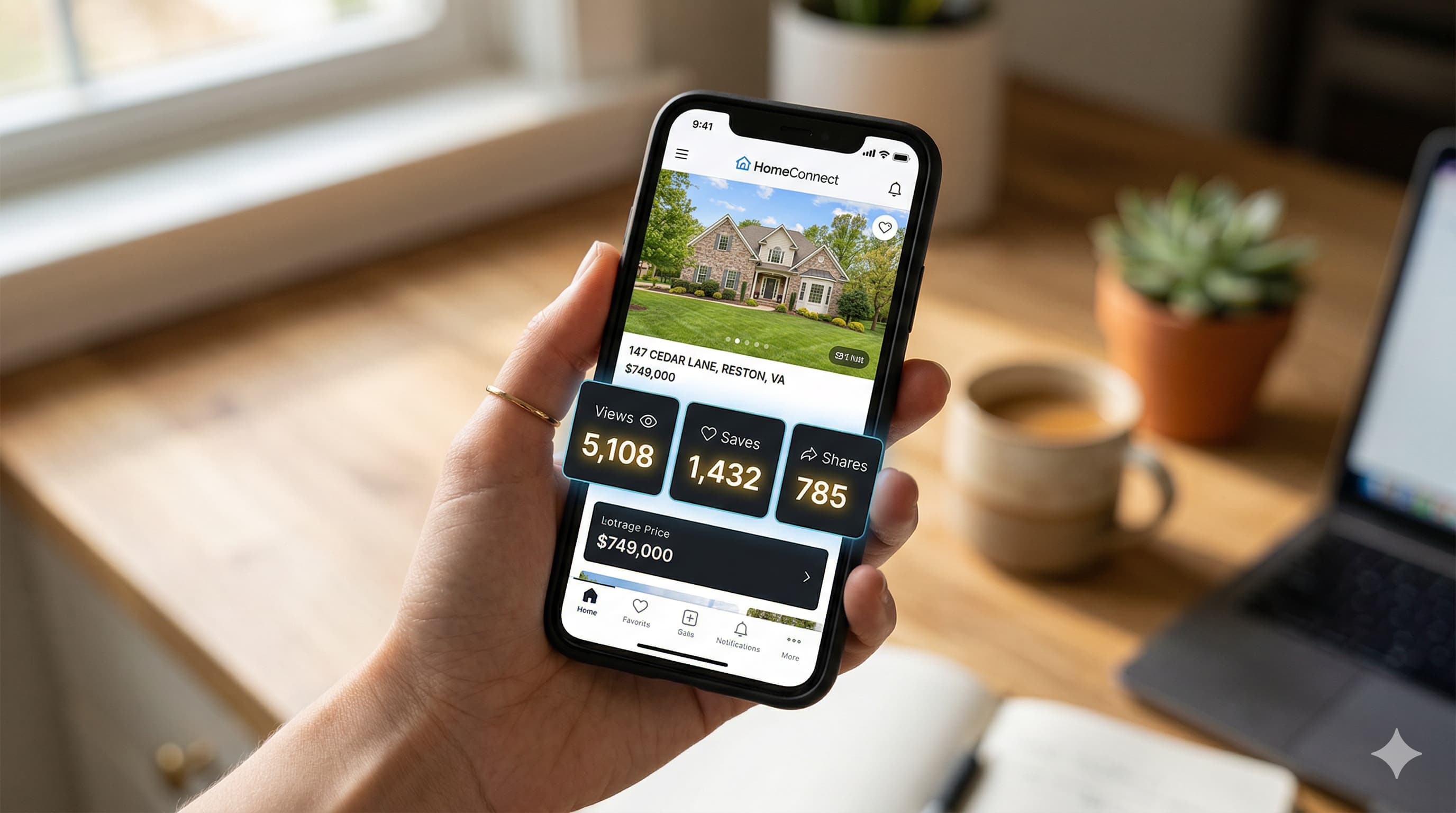
When a home goes live on Zillow, most sellers start watching the view count the way you’d watch a flight tracker: constantly, anxiously, and without quite knowing what the numbers mean. Is 300 views good? Is 80 saves a lot? What does it mean when shares spike on a Tuesday?
A new analysis from Zillow Research has answers to those questions. Published in spring 2025, the study analyzed thousands of listings dating back to spring 2023 and found clear correlations between early Zillow engagement and two outcomes sellers care most about: how fast a home sells and whether it closes at or above list price.
The findings are useful. But they’re also easy to misread, especially in a market like Reston and Herndon, where homes often move faster than the national average and the buyer pool has some distinct characteristics that affect how these numbers play out. Here’s what the data says, how to interpret it, and what to watch for when your own listing goes live.
The Benchmarks: What Good Looks Like
Zillow’s analysis gives sellers a concrete framework for the first week after a listing goes live. The national median home goes to pending in about 15 days and sells at 98% of the list price. That’s the baseline. From there, engagement levels either confirm you’re on track or signal something needs attention.
Views
250 views per day puts a home on pace to go under contract in roughly one week, with about 75% of those homes sold within two weeks. Push that above 500 daily views and homes frequently close at or above list price. On the lower end, a listing averaging fewer than 25 views per day is showing almost no traction, which usually means something fundamental needs to change before the launch window closes.
Saves
Five saves per day is where things get interesting. Sellers who hit that threshold in the first week typically accept an offer within seven days. Hit 10 or more saves per day and the home is more likely to close above asking. Saves represent a meaningful step: a buyer paused, thought about it, and decided to come back. That’s different from a passing click.
Shares
Ten shares per day correlates with reaching pending status in about a week. Exceed 20 per day and the listing commonly sells over list price. Shares are the easiest metric to underestimate because they happen behind the scenes. When someone texts a Zillow link to a spouse, emails it to their agent, or drops it in a family group chat, Zillow logs it. You never see the conversation, but you see the share count, and it’s one of the more reliable signals that a home has generated emotional buy-in from a real prospect.
What the Gap Between Views and Saves Is Telling You
Here’s where this data becomes genuinely useful as a diagnostic tool rather than just a scoreboard.
Views and saves measure different things. Views measure reach. Saves measure resonance. A listing can get 600 views a day and still sit on the market for six weeks if buyers keep looking and leaving without saving.
If your view count is strong but your save rate is low, that gap is telling you something specific.
High views, low saves usually points to a pricing or photography problem. Buyers are finding the home. The search algorithm is surfacing it, the thumbnail is getting clicks, the location is relevant to what they’re searching for. But once they open the listing, something isn’t connecting. Either the price feels off relative to what they’re seeing inside, or the photos aren’t showing the home at its best, or both.
In Reston and Herndon, where many buyers are doing thorough online research before they ever schedule a showing, photo quality carries more weight than it might in markets where buyers make decisions more impulsively. A relocation buyer moving from Seattle or Chicago is doing exhaustive Zillow research from their current city. They’re building a mental model of your home based on images alone. If the photos are dark, poorly staged, or shot with a phone, the save rate will reflect it.
High saves relative to views suggests targeted, high-intent buyers. When a listing is converting a significant portion of its viewers into saves, it means buyers who are finding it are interested enough to mark it for follow-up. That’s a good sign for price and presentation, but it can also mean the listing isn’t getting enough exposure, depending on the raw numbers. A home saving 8 people per day from 80 daily views has a terrific conversion rate but may need more marketing to widen the funnel.
Low engagement across the board is usually a pricing problem. When a listing isn’t getting found in searches, it often means buyers have filtered it out based on price. Zillow’s search algorithm factors in price-to-market-value comparisons, and if a home is priced above what comparable sales support, it will surface lower in search results and generate fewer views to begin with.
What This Looks Like in the Reston and Herndon Market
The Zillow benchmarks are national numbers. Reston and Herndon tend to outperform them.
Northern Virginia has been running well below the national median for days on market for years. A well-priced home in a neighborhood like North Point, Hunters Woods, or Lake Anne in Reston can go under contract in days, not weeks. Same for townhomes and condos near Reston Town Center or close to the Silver Line Metro stations at Wiehle-Reston East and Reston Town Center station.
That compression matters for how you read the first-week engagement data. If the national benchmark for a one-week sale is 250 views per day, a well-priced Reston listing should probably be hitting that number and pushing higher. When a home in this market is only averaging 80 to 100 daily views in its first week, that underperformance is more alarming than it would be in a slower market. The window here is short. You don’t get the luxury of a slow build.
Reston and Herndon also draw a particular kind of buyer. The area has a heavy concentration of tech workers, federal contractors, and government employees, and it consistently draws relocation buyers because of proximity to Dulles Airport, major employers along the Dulles Corridor, and the convenience of the Silver Line for anyone commuting into D.C. These buyers tend to be methodical and research-driven. They spend time on Zillow before they spend time in a car. That means your listing’s online presentation isn’t just a marketing exercise. It’s the first showing.
For that buyer profile, saves and shares carry extra weight. A relocation buyer who saves your home has likely already cross-referenced it against comparable listings, checked the commute times, looked up the school ratings, and decided it warrants a closer look. That save represents real consideration, not a casual click.
A Word on What These Numbers Can and Can’t Tell You
This is worth saying clearly: Zillow engagement metrics are correlations, not causes. A high save rate does not make offers happen. It reflects demand that already exists. And demand is shaped by pricing, presentation, location, timing, and a dozen other factors that engagement data doesn’t capture directly.
It’s also worth understanding just how many Zillow users are not active buyers.
Zillow attracts roughly 227 million unique monthly users. The platform gets over 10 billion visits annually. Of those visitors, only about 18% indicate any intention to buy a home, and only 3% actually complete a home purchase. Meanwhile, Zillow generates approximately 16.9 million leads per year for agent advertisers in a year when roughly 4.26 million homes are actually sold nationally.
The point is not that Zillow data is meaningless. The point is that the ocean of views and saves on any given listing includes a lot of people who are years away from buying, have no intention of moving to Reston, or are simply browsing the way people browse social media. Your 400 daily views are not 400 serious buyers. Some of them are neighbors checking what your house is worth. Some are people who will never leave their current zip code.
What the engagement benchmarks do is help filter signal from noise. When you’re hitting 500 views a day and 12 saves, the data suggests that a meaningful portion of that traffic is genuine. When you’re at 60 views and 1 save, something is broken regardless of how many total people are theoretically on the platform.
How to Use This During Your Listing
Before you go live. The benchmarks give you a concrete framework for what success looks like in week one. Going into a listing launch without any sense of what good Zillow engagement looks like is like leaving for a road trip without knowing the destination. These numbers give sellers a target so that first-week results can be evaluated against something real rather than a gut feeling.
During the first seven days. Zillow’s analysis focuses specifically on the first seven days of a listing or until it goes pending, whichever comes first. This is intentional: the launch window is when engagement is highest, when buyer interest peaks, and when the pricing signal is freshest. Pulling the views, saves, and shares at day three and day seven gives you two data points to trend. Engagement that starts strong and holds is a good sign. Engagement that starts strong and drops sharply often means the initial interest came from the listing notification surge, and the underlying demand isn’t supporting the price.
Before a price reduction conversation. Showing a seller that their home is averaging 75 views per day when the benchmark for a one-week sale is 250 is a more productive conversation than simply saying the market isn’t responding. The data puts a number on what “not enough activity” actually looks like. It shifts the conversation from subjective impressions to something measurable. And it makes the case for a pricing adjustment or a presentation change in a way that feels analytical rather than adversarial.
Diagnosing high views with low saves. If a listing is getting 300 or 400 daily views but saving fewer than three or four buyers per day, the question isn’t whether to reduce the price. It’s whether the listing presentation is converting the traffic it’s already getting. That might mean new photography, a rewritten listing description that calls out features buyers in this area actually care about (commute access, home office space, outdoor living), or a staging refresh before relaunching.
What Zillow Research Says About Standing Out
The Zillow analysis also notes that highlighting certain features in a listing can improve both speed and price outcomes. Calling attention to things like outdoor TVs, soapstone countertops, and outdoor showers has been linked to premium sale prices. Features like frameless showers, plant ledges, and terrazzo flooring tend to correlate with faster-than-expected sales.
For Reston and Herndon sellers specifically, a few additional things tend to matter to buyers in this market: proximity to the trail network (the Washington and Old Dominion Trail and Reston’s 55-mile trail system are genuine selling points for the right buyer), dedicated home office space or a flexible room that could function as one, and any recent updates to kitchens or baths. These aren’t universally Zillow-tracked features, but they belong in the listing description and the photo sequence if they’re present.
The Bottom Line
Zillow engagement numbers are one of the more honest real-time signals available during a listing. They don’t tell the whole story, and a high save rate won’t manufacture offers that the price or presentation don’t support. But used correctly, the view-to-save ratio in the first week tells you whether buyers are finding your home and whether they’re connecting with it once they do.
In a market like Reston and Herndon, where the decision window is short and buyers often arrive well-informed, those first seven days carry a lot of weight. Knowing what the numbers should look like, and knowing how to read the gap between views and saves, gives sellers something concrete to work with instead of just waiting and hoping.
If you’re thinking about listing a home in Reston or Herndon and want to understand what a strong launch looks like in this specific market, reach out to Graham and Kathy at Greater Reston Living. We’re happy to walk through what realistic engagement benchmarks look like for your neighborhood and price point before you ever hit the market.