
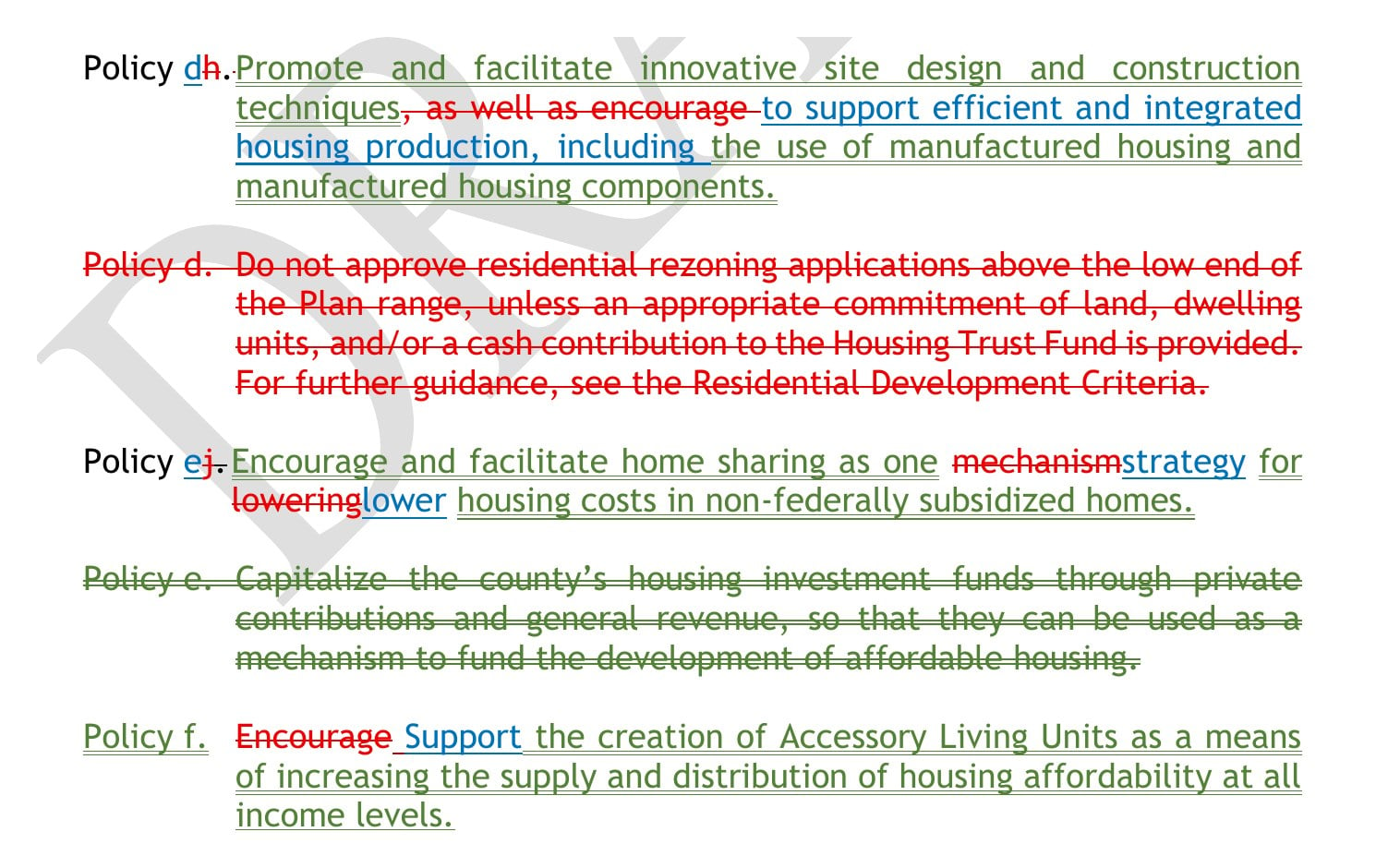
Fairfax County is taking public comment through December 18 on the second phase of Plan Forward, its rewrite of the Policy Plan, the countywide volume of the Comprehensive Plan that guides how land gets developed. In the draft Housing Element, county staff deleted a policy directing the Board of Supervisors not to approve residential rezonings above the low end of a property’s planned density unless the builder commits land, homes or money to affordable housing.
Staff added a new policy to “encourage residential development that maximizes planned densities to strengthen the county’s overall housing supply.” They also added a policy to promote “compatible infill development within existing residential areas and Suburban Village Centers to diversify the housing stock and expand lower-cost housing options.”
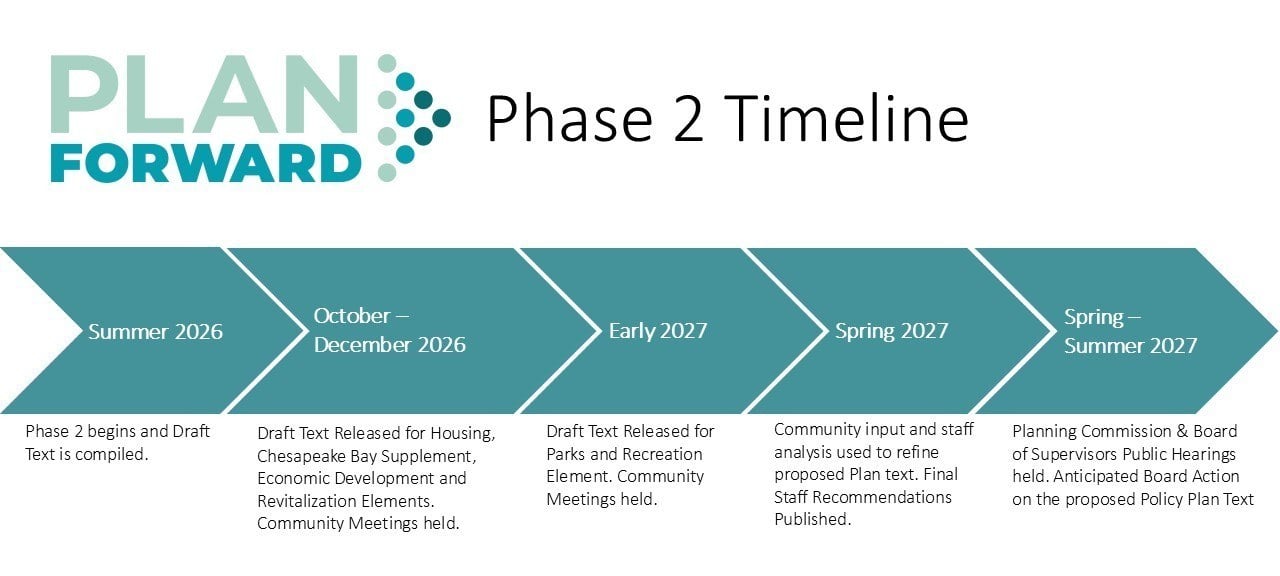
The county released the draft on October 23 and sent out a call for comments on November 4. Comments are due Friday, December 18, and county staff plan to publish revised text and a staff report in spring 2027, with Planning Commission and Board hearings to follow that spring and summer.
The draft applies to Reston and the unincorporated parts of Herndon, including Oak Hill, McNair and the Floris area. It does not apply inside the Town of Herndon, which writes its own plan.
The Policy Plan guides rezoning decisions, and no lot changes until an owner files a case
Fairfax County’s Comprehensive Plan has two layers. The Policy Plan sets countywide goals for land use, housing, transportation, parks and the environment. The Area Plans add guidance for specific places, and Reston has its own, the Reston Comprehensive Plan the Board adopted in September 2023. Neither one is zoning. The Board weighs both when a property owner applies for a rezoning, a request to change what the zoning on a parcel allows.
Adopting the Housing Element would rezone no property and approve no project. It would change the guidance the Planning Commission and the Board read when a builder asks to put more homes on a site.
The Board adopted Phase 1 of Plan Forward on December 9, 2025, covering land use, transportation, the environment and several other elements. Phase 2 covers housing, a combined economic development and revitalization element, parks and recreation, heritage resources and the Chesapeake Bay Supplement. The housing, economic development and Chesapeake Bay drafts are out for comment now. The county expects to release parks and recreation in early 2027 and heritage resources later, with completion planned for early 2028, according to the Phase 2 project page.
The draft deletes the low-end density rule and the 12 percent affordable housing target
Most residential land in the county plan carries a density range, such as two to three homes per acre. Under the current Policy Plan, the Board should not approve a rezoning above the low end of that range unless the builder offers an affordable housing commitment. County staff deleted that policy in the draft.
The county would still expect affordable housing from residential projects. Staff moved a policy into the Housing Element from the county’s existing rezoning criteria: residential projects not subject to on-site affordable units should commit land, homes or a cash contribution to the county’s Housing Trust Fund equal to 0.5 percent of the value of the units approved. The county’s Affordable Dwelling Unit program, which requires price-restricted homes in larger new developments under the zoning ordinance, stays in place.
Five changes in the draft:
| Topic | Current Policy Plan | October 23 draft |
|---|---|---|
| Density on residential rezonings | “Do not approve residential rezoning applications above the low end of the Plan range” without an affordable housing commitment | Deleted. New policy: “Encourage residential development that maximizes planned densities” |
| Annual target | Add affordable units each year equal to at least 12 percent of the previous year’s total housing production | Replaced by a goal to expand overall supply and “keep pace with job and population growth” |
| Where to add homes | Promote multifamily and senior housing in Mixed-Use Centers and existing residential areas, “as appropriate” | Promote higher density in Mixed-Use Centers and “compatible infill development within existing residential areas and Suburban Village Centers” |
| Accessory living units | “Encourage the creation of Accessory Living Units” | “Support the creation of Accessory Living Units,” now listed under the housing supply objective |
| Workforce Dwelling Units | Expected in Mixed-Use Centers, Transit Station Areas and projects planned at 8 or more homes per acre | Suburban Village Centers added to that list |
Workforce Dwelling Units, or WDUs, are homes priced for households earning up to 100 percent of the area median income in for-sale projects and up to 80 percent in rentals. County staff kept the minimums of 12 percent affordable or workforce units in for-sale projects and 8 percent in rentals, and the density bonus builders earn for providing them, 12 percent and up to 20 percent on a sliding scale.
Two smaller policies carry over with new wording: one supporting manufactured housing and factory-built components, and one encouraging home sharing as a way to lower housing costs.
Fairfax County has not named any Suburban Village Centers yet
The county added the Suburban Village Center category in Phase 1 and defines these places as “mixed-use community focal points” in suburban neighborhoods along arterial roads. Sully District Supervisor Kathy Smith wrote in an August board matter that such areas “may be suitable for mixed-use development, including medium intensity residential use.” On August 25, the Board moved that planning work to the top tier of the county’s plan amendment work program, FFXnow reported.
No list of Suburban Village Centers exists. Smith said the criteria and designations would reflect how much these shopping areas differ from one another, and the Board set no deadline for staff. Hunter Mill District Supervisor Walter Alcorn, who represents Reston, said the goal is to build on existing development, especially near transit.
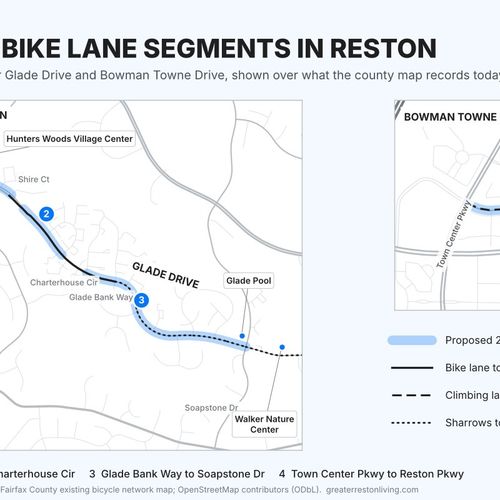
Reston’s plan names five village centers: Lake Anne, Hunters Woods, South Lakes, North Point and Tall Oaks, where homes have since replaced the shopping center. Reston’s planners used the name decades before the county created its new category, and the county has designated none of them a Suburban Village Center.
Housing at Hunters Woods, South Lakes or North Point would still need an amendment to Reston’s 2023 plan
When the Board adopted the Reston Comprehensive Plan in September 2023, it kept residential density in the village centers at existing levels and removed the option to redevelop their shopping areas with housing, except at Lake Anne and Tall Oaks, The Connection reported. Adding homes at Hunters Woods, South Lakes or North Point would take another amendment to the Reston plan. The Policy Plan rewrite does not amend that text.
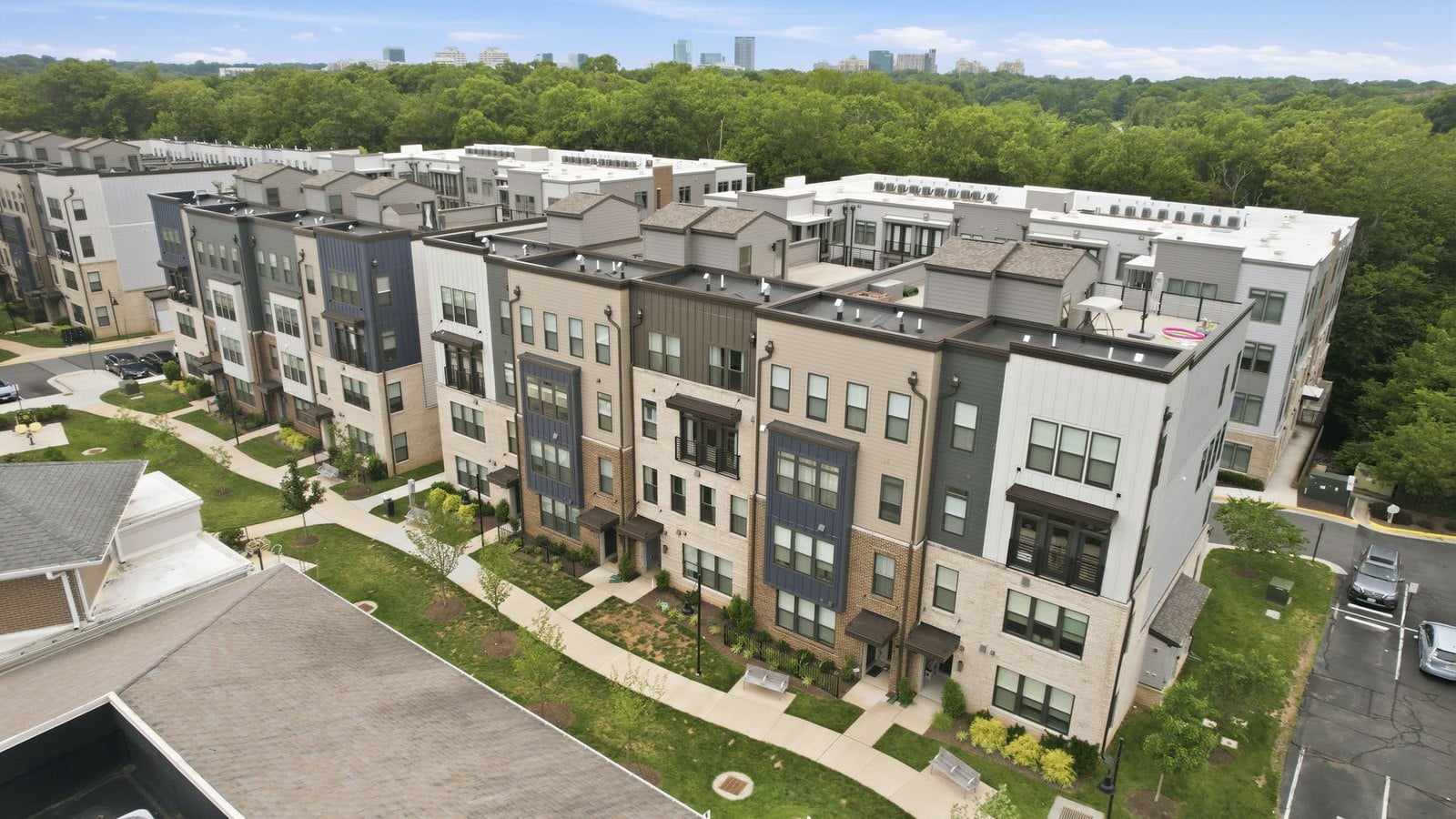
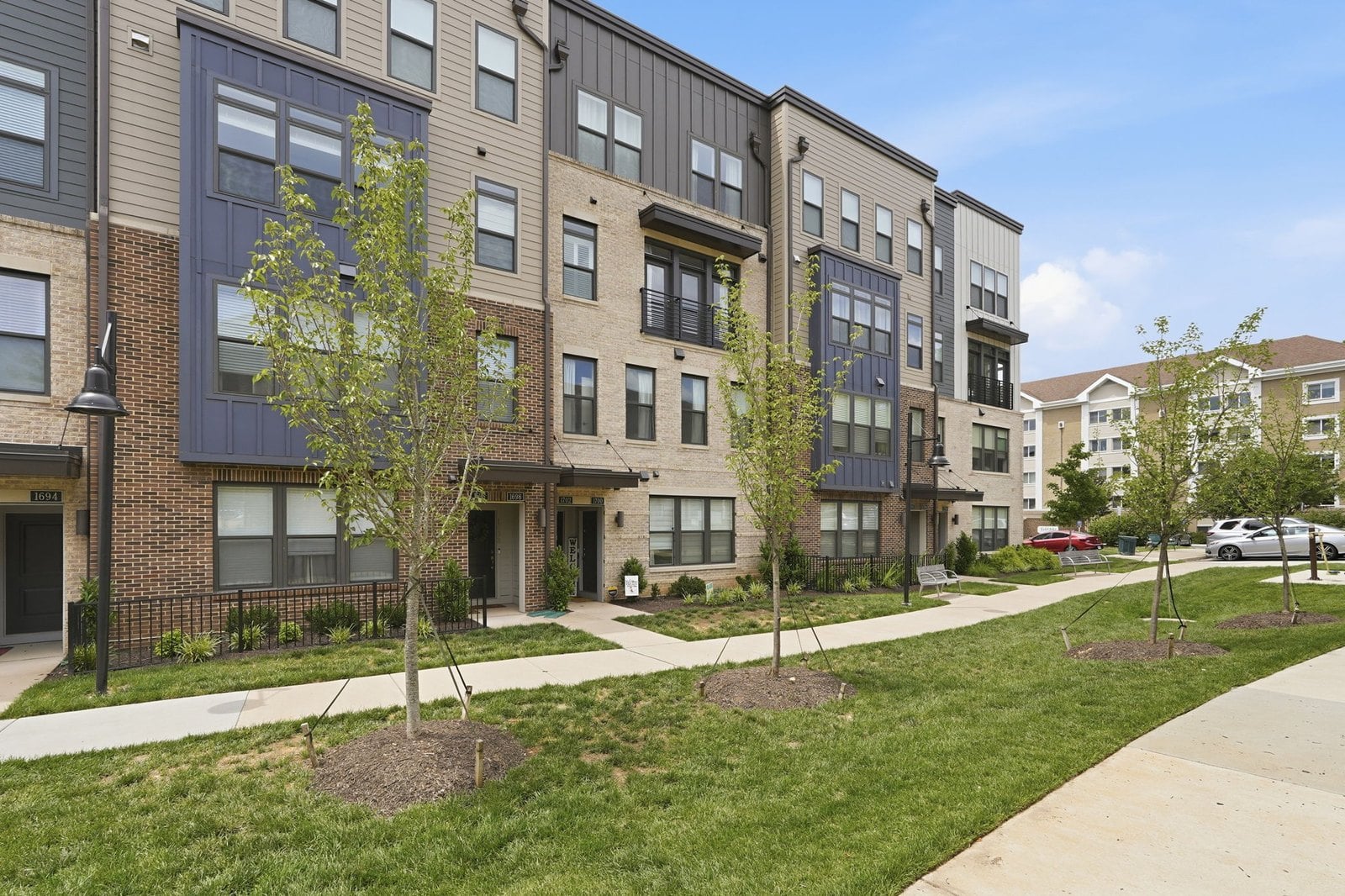
At Tall Oaks, the Giant closed in 2007, the two grocers that followed it failed, and the Board approved replacing the shopping center with homes in 2016. Stanley Martin built 156 townhouses and condominiums on Bandit Loop between 2019 and 2023. Our Tall Oaks and Uplands guide covers what those homes sell for now.
The county also designates Lake Anne a Commercial Revitalization Area, a status for older commercial areas that need help attracting reinvestment. County staff list it with Lincolnia and Merrifield as the county’s three such areas in the draft Economic Development and Revitalization Element, which is out for comment on the same schedule and supports incentives and regulatory flexibility in those areas. Our Lake Anne neighborhood guide covers the plaza and the homes around it.
The Board holds its hearing on backyard cottages and basement apartments on November 17
The Housing Element refers readers to the Land Use Element for the details of “compatible infill.” For an owner of a detached house, the nearer change is the county’s accessory living unit rules, which the Board takes up this month. An accessory living unit, or ALU, is a second home on a single-family lot, such as a basement apartment or a backyard cottage.
The Board of Supervisors holds a public hearing on rewritten ALU rules on Tuesday, November 17, at 4:30 p.m. at the Government Center. On November 4, the Planning Commission recommended approval with changes, Annandale Today reported. The commission would keep the requirement that the owner live on the property, allow up to four occupants, and allow detached cottages by right on lots of at least 15,000 square feet, down from the 36,000 square feet county staff had proposed. It rejected a motion to allow units in townhouses by special permit.
Under the commission’s version, about half of Reston’s detached houses would have lots large enough for a cottage by right. County assessment records list 2,615 of Reston’s 5,143 detached homes on lots of 15,000 square feet or more, a count we ran for our October post on backyard cottages. Reston’s 8,704 townhouses would remain excluded. Reston Association’s Design Review Board would still have to approve any new structure or exterior change. The Board can adopt the commission’s version, the staff version or another option within the advertised range.
The Town of Herndon has its own accessory dwelling rules, and the county decision does not change them.
The rewrite leaves zoning, the Reston plan and RA’s covenants as they are
- Zoning. No property changes zoning. Any added density still requires an application, a staff review and public hearings.
- The Reston plan. The site-by-site guidance in the Reston Comprehensive Plan, including the village center limits above, stays as adopted.
- The Town of Herndon. The town follows its own comprehensive plan, covered in our post on Herndon 2050, and the county Policy Plan does not apply there.
- Reston Association. RA’s Deed and Design Review Board apply on their own terms, whatever the county’s plan says.
- Affordable housing minimums. The ADU program and the WDU percentages stay the same.
Send comments by December 18
- Planning Commission Policy Plan Committee: discusses the Housing Element and the Chesapeake Bay Supplement on Thursday, November 5, at 7:30 p.m.
- Community meeting on the Housing Element: Monday, November 9, at noon, on Microsoft Teams. Call in at 571-429-5982 with access code 447 946 768#. A recording of the October 26 meeting is on the Phase 2 project page.
- Economic Development and Revitalization Element: the Policy Plan Committee takes it up on Thursday, November 19, at 7:30 p.m.
- Comments: email [email protected] or use the form on the county’s Plan Forward Phase 2 page. The county also posts a community meeting toolkit for neighborhood groups.
- Questions: Corinne Bebek of the Department of Planning and Development, 703-324-1237.
For a homeowner in Reston or unincorporated Herndon, the draft would change what the county says it wants when builders ask for more homes. The rules on each lot stay the same until someone files a case. A builder who asks for more homes on a site would find a plan that encourages using the full planned density and calls for infill, where the current text tells the Board to hold at the low end without an affordable housing commitment. Whether the change produces townhouses near a shopping center or basement apartments on cul-de-sacs depends on the Board’s ALU decision and on cases filed after the Board adopts final text in 2027.
We follow these cases because they shape what gets built near the homes our clients buy and sell. Reach out if you want to talk through how a plan change near you could affect a sale or a purchase.
See something missing or wrong? Email us at [email protected] and we will check it and update the post.