
Step off the Silver Line at Wiehle-Reston East and you have a choice. Walk north and you land in Reston Station, with its plaza, its restaurants, and its office towers. Walk south across the pedestrian bridge over the Dulles Toll Road and you land next to a parking garage attached to a 1990s office park. That office park is called Commerce Metro Center, and it may be the most consequential 16 acres in Reston right now.
Comstock, the Reston-based developer behind Reston Station, owns the property and filed to rezone it back in February 2022. Four years and five plan submissions later, the project is moving into its final stretch of county review. We read the entire 115-sheet development plan dated May 13, 2026, the latest draft proffer statement, and Comstock’s April presentation to county commissioners so you don’t have to. This post covers what is planned, what the developer has committed to in writing, what is still uncertain, and what it all means if you live, rent, or own anywhere near the Wiehle corridor.
Where This Is and Why It Matters
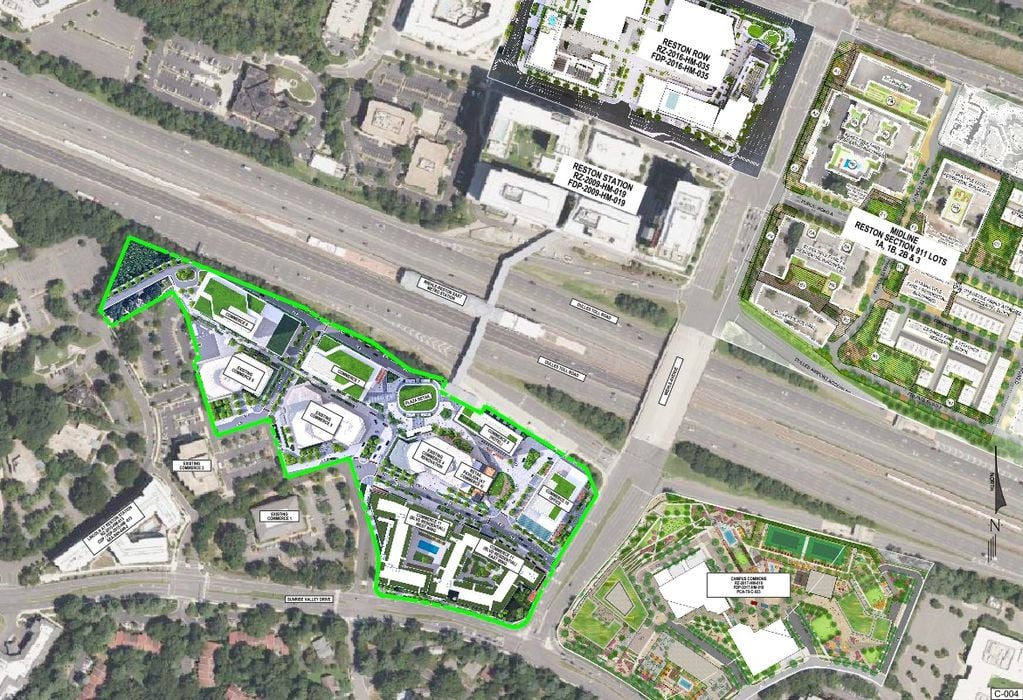
Commerce Metro Center sits south of the Dulles Toll Road, west of Wiehle Avenue, and north of Sunrise Valley Drive. It is the land you see from the south entrance of the Wiehle-Reston East Metro station, currently home to a handful of mid-rise office buildings and the surface lots and garages around them. Comstock has spent years assembling the parcels here, and the company has been open about its ambition: Reston Station was always pitched as an 80-acre district spanning both sides of the toll road, and the north side got built first.
This application, known formally as RZ 2022-HM-00004, is the southern half catching up. The Reston Association has tracked the project since the beginning, and FFXnow covered the original 2022 filing when it called for 469 homes and a smaller hotel. The plan has evolved considerably since then, and the version now in front of the county is bigger on the residential side and far more specific about what the community gets in return.
The Big Picture: 2.4 Million Square Feet
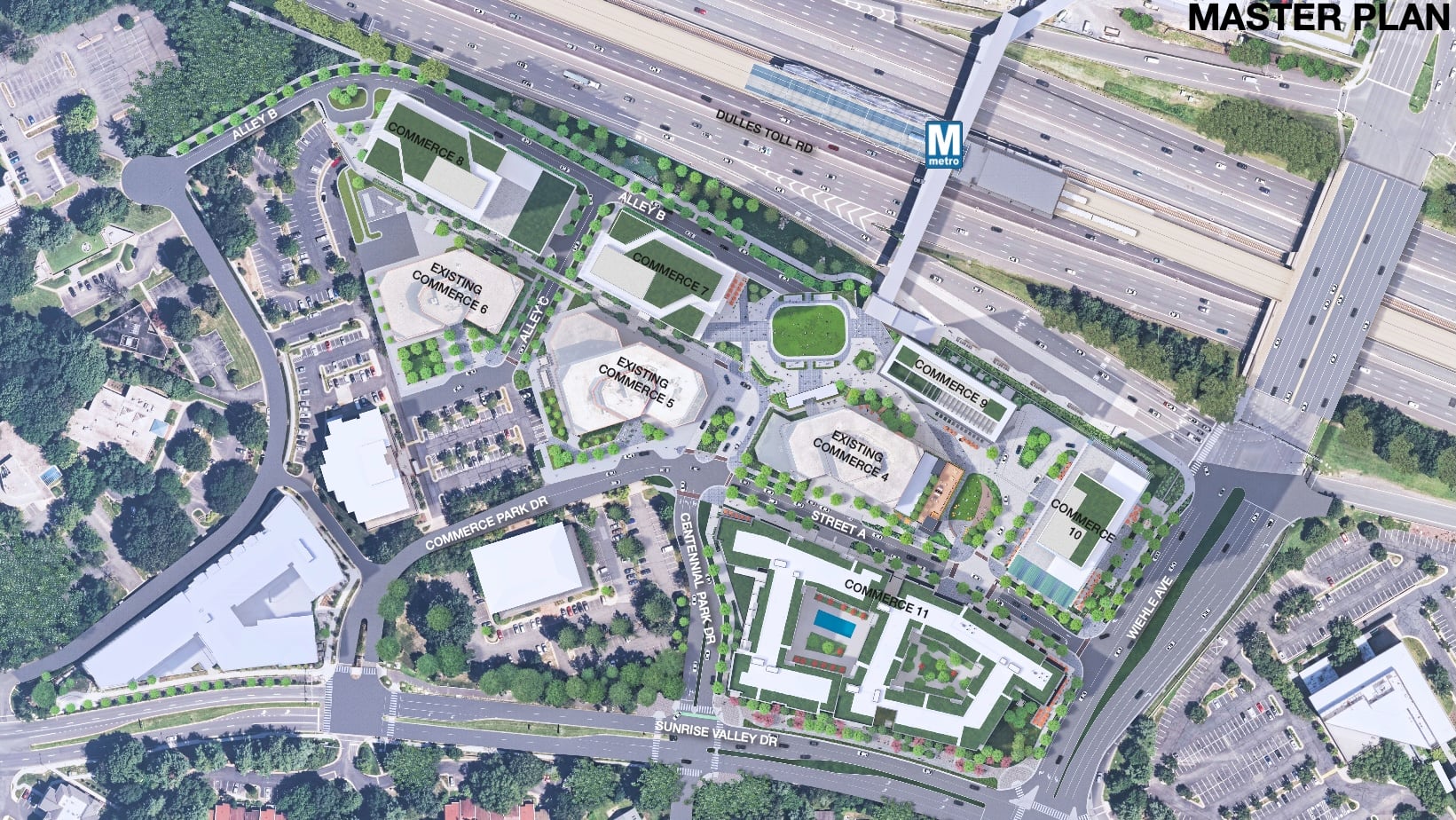
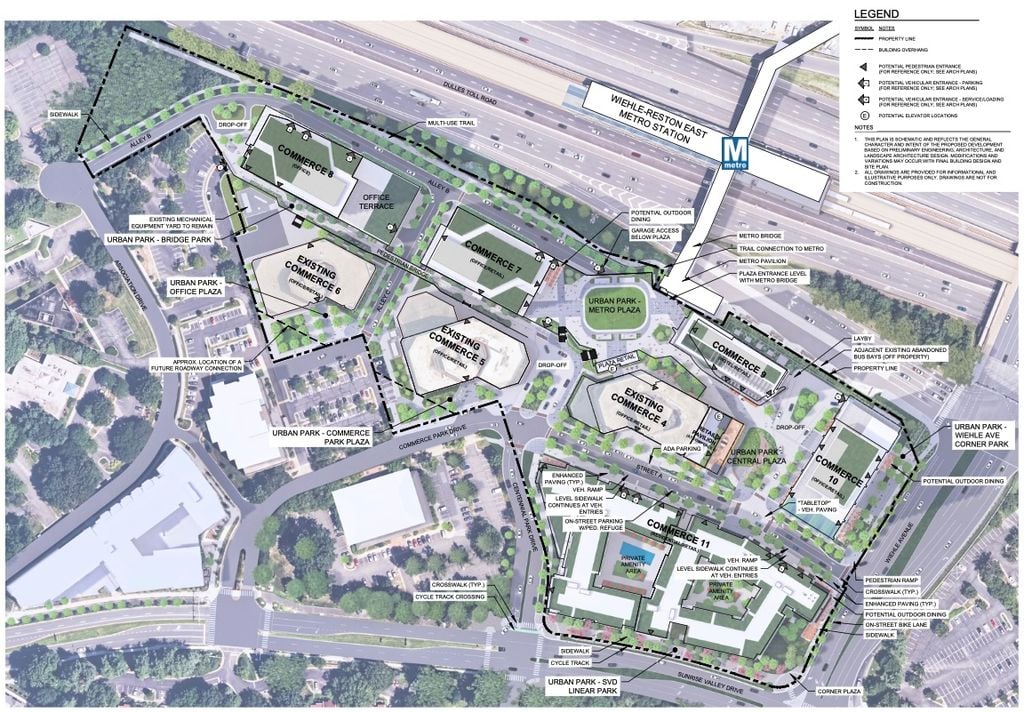
At full build-out, the plan allows just under 2.4 million square feet of development on the site. One existing office building comes down: Commerce 3, about 106,000 square feet. Three existing buildings, Commerce 4, 5, and 6, stay in place and keep operating. Around them, Comstock would add:
- Three new office towers totaling roughly 1.25 million square feet. Commerce 7 and 8 rise up to 16 stories along the toll road frontage. Commerce 10 anchors the Wiehle Avenue corner.
- A 240-room hotel, Commerce 9, up to 16 stories, positioned beside the new Metro Plaza.
- Up to 540 homes in Commerce 11, a pair of 7-story residential wings along Sunrise Valley Drive.
- Roughly 44,000 square feet of retail spread across building ground floors plus two small standalone pavilions.
- An optional grocery store of about 14,500 square feet, shown at the first garage level. Small-format scale, closer to a Trader Joe’s than a Wegmans.
- Seven named parks and plazas covering 20 percent of the site, above the 15 percent the county requires.
The Tower at the Corner
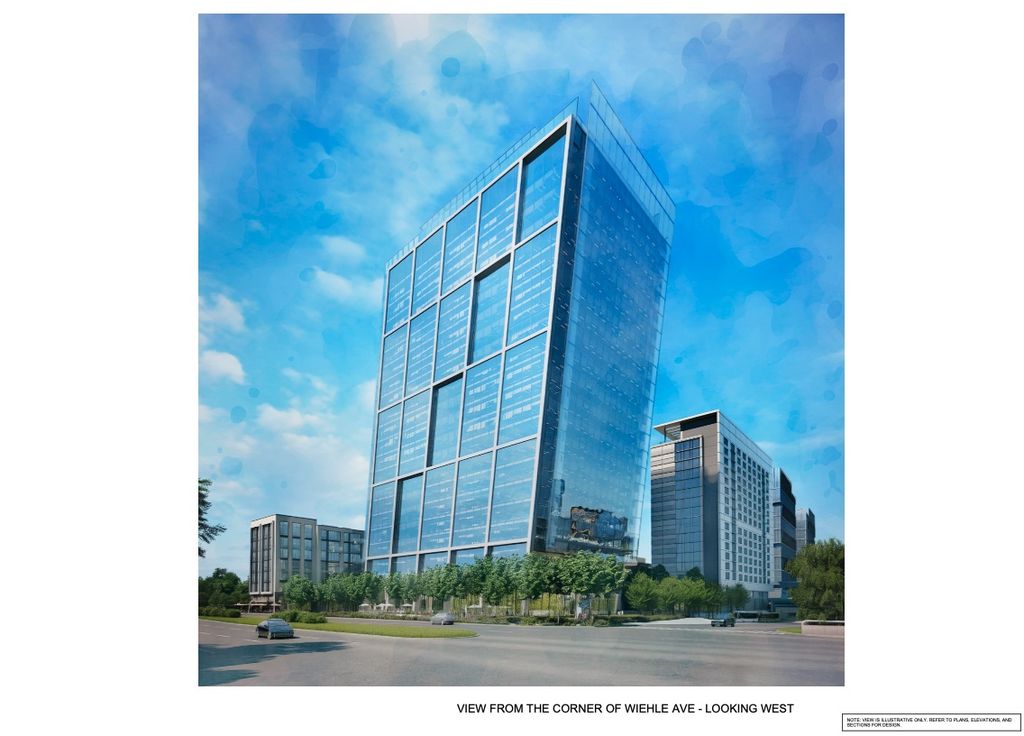
The signature building is Commerce 10, an office tower of up to 21 stories and 340 feet at the corner of Wiehle Avenue and the new internal Street A. The design comes from Jahn, the Chicago firm founded by the late architect Helmut Jahn. If that name sounds familiar, it should: Jahn designed 1900 Reston Metro Plaza, the distinctive tower on the north side of the station. The renderings in the plan set show a dramatic angled glass facade, and the clear intent is a pair of Jahn buildings framing the toll road crossing as a gateway. Perkins Eastman serves as master planner for the overall site.
The Homes, and Who They Are For
Commerce 11 is where the residential story lives, and it is a different product than most of what has delivered around the station so far. The planning assumptions show a quarter of the units as three-bedrooms, which is rare in transit-oriented buildings anywhere in Northern Virginia. Most Metro-adjacent apartments skew hard toward studios and one-bedrooms. A meaningful three-bedroom share signals that families are part of the intended audience here, not just commuters.
The affordability commitment is now in writing too. The latest draft proffers commit a minimum of 16.2 percent of all residential units as Workforce Dwelling Units. On 540 homes, that works out to roughly 87 income-restricted units. If the building is rental, half of those units serve households earning up to 80 percent of area median income, a quarter serve households at up to 70 percent, and a quarter reach down to 60 percent. For a property a short walk from a Silver Line platform, those numbers matter. Housing close to transit is exactly where affordable units do the most good, because residents can shed car costs along with rent burden.
One more detail caught our eye. The proffers include machinery for a tax-district buyout that only becomes relevant if residential condominium documents are ever recorded. That does not mean condos are coming. It does mean Comstock is preserving the option of for-sale homes at Commerce 11 rather than committing to rental only, which is worth watching if you have been waiting for new for-sale inventory near the Metro.
A Brewery, a Grocer, and the Retail Question
The retail program is modest by design, about 44,000 square feet total, concentrated where people will walk: the Metro Plaza, the central plaza, and the ground floor of the residential building. Two details stand out.
First, the brewery. Comstock’s April 2026 presentation to county commissioners includes a feedback summary from a prior session, and one line jumps off the page: the brewery planned at the Commerce 4 retail pavilion was called a positive addition. No operator has been named, and plans can change, but it is the first concrete tenant concept attached to the project. It also fits a pattern we have written about before: from Hawkley in Herndon to NH44 at Arrowbrook Centre, breweries have become the amenity developers reach for when they want to signal a neighborhood is worth your evening, not just your workday.
Second, the grocer. The plan reserves about 14,500 square feet at garage level B1 for an optional grocery store, with its own dedicated parking ratio. The south side of Wiehle Avenue has no walkable grocery today, so even an option on paper is meaningful for the Sunrise Valley corridor and the clusters nearby. We will be honest about the uncertainty: the word is optional, and the April presentation does not mention the grocer at all. Treat it as a possibility, not a promise.
Seven Parks and a Plaza You Can Walk to Without Stairs
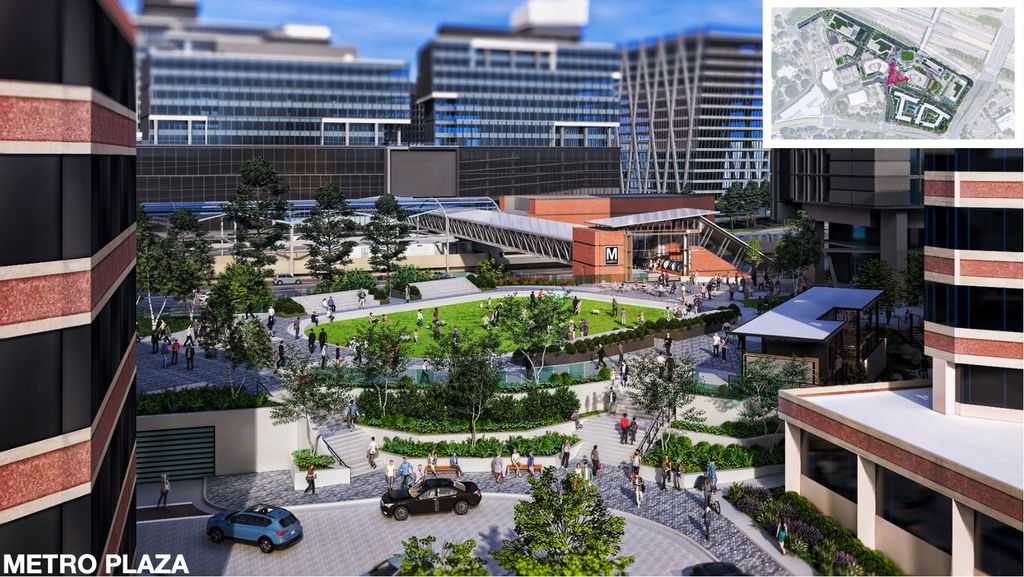
The public realm is the heart of Comstock’s pitch, and the centerpiece is the Metro Plaza. Today, the pedestrian bridge from the station deposits you at garage level on the south side. Under the plan, the bridge would land directly on a roughly 46,000 square foot plaza at the same elevation, no stairs or escalators required, ringed by the hotel, retail pavilions, and a flexible lawn programmed for events. The latest proffer draft grew the Metro Plaza by about a quarter and doubled the nearby Bridge Park to 15,000 square feet, while trimming several smaller plazas between the office buildings. Read that however you like; our take is that the space the most people will use got bigger.
The full park list runs seven deep: the Metro Plaza, a central plaza by the existing Commerce 4 building, a linear park with a 10-foot cycle track along Sunrise Valley Drive, a pocket park at the Wiehle corner, the Bridge Park, and two smaller plazas on the office side of the site. Each carries a construction trigger in the proffers tying it to a specific building, so the parks cannot all be saved for last. A multi-use trail runs the length of the toll road frontage, and the proffers commit space and an easement for a new Capital Bikeshare station with up to 20 docks.
The Elusive Tunnel Under Wiehle Avenue
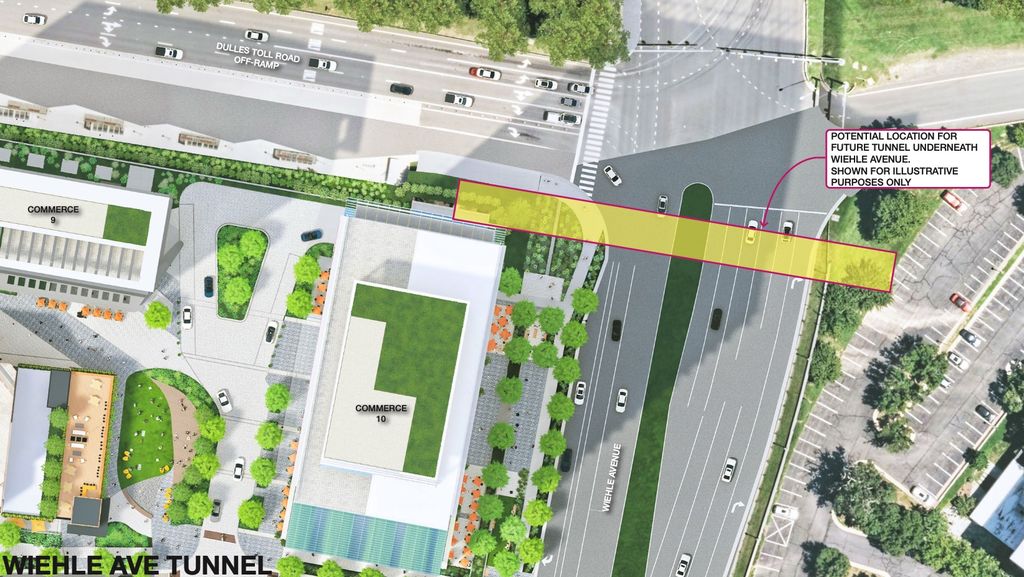
Buried in the April commissioner presentation is a slide titled Wiehle Avenue Tunnel Concept. It shows a potential future pedestrian tunnel running underneath Wiehle Avenue near the toll road ramps, connecting the Commerce 10 corner toward the east side of the street. The slide is labeled illustrative only, and there is no proffer commitment behind it, so we want to be precise: this is a studied concept, not a proposal.
Still, it is a striking idea. Anyone who has tried to cross Wiehle Avenue on foot near the toll road understands the problem. The intersection moves enormous volumes of traffic, the crossing distances are long, and the experience is unpleasant at best. A grade-separated crossing would change how the east and west sides of Wiehle relate to each other, and it hints at how Comstock may eventually think about knitting this site to its landholdings east of the avenue.
What the Community Gets in Writing
Rezonings in Fairfax County run on proffers, the binding written commitments a developer makes as a condition of approval. A playground in north Reston just reopened this month partly on proffer money, which is a useful reminder that these line items turn into real things over time. Here is what the May 2026 draft commits, beyond the workforce housing covered above:
- Transportation: contributions to the Reston Road Fund of $2,595 per home and $11.87 per square foot of new commercial space, which pencils out to a figure in the range of $17 million before credits, plus $350,000 specifically for Wiehle Avenue improvements tied to the county’s corridor study, and a framework for a possible new traffic signal at Sunrise Valley Drive and Centennial Park Drive.
- Schools: $14,956 per projected student. The county formula projects about 58 students from 540 transit-oriented homes, putting the contribution near $870,000.
- Recreation: $1.72 per square foot of new development to the Park Authority for athletic facilities serving Reston, plus a minimum recreation spend inside the residential building itself.
- Environment and design: LEED Silver targets for the office and hotel buildings backed by escrow money the county keeps if certification falls short, bird-friendly facade design on every new building, noise standards that prohibit balconies on units exposed to the loudest toll road noise, a dog walking area, and public art coordinated with Public Art Reston.
- Trip reduction: a transportation demand management program with a goal of cutting peak-hour car trips by 55 percent compared to standard rates, one of the more aggressive targets in the station areas.
The Caveats
Three things deserve plain language. First, the office bet is enormous. A million and a quarter square feet of new office space is a contrarian position in 2026, and Comstock knows it. The plan is structured for flexibility: construction can proceed in two phases in any order, meaning the homes and hotel can lead while the office towers wait for tenants, and the developer keeps the right to maintain interim surface parking on future building pads in the meantime.
Second, some things from the original 2022 filing are gone. The childcare center that appeared in early coverage no longer shows up in the proffers, and as noted above, the grocery store is an option rather than a commitment.
Third, the timeline. The rezoning has not yet been approved. After approval come site plans, permits, and phased construction that the proffers explicitly tie to market conditions. Even on an optimistic path, the first new buildings are years away and full build-out is a 2030s story. Nobody should change their housing plans this year because of this project. But if you own near the corridor, the long arc matters: surface parking becoming parks, retail, and possibly groceries within walking distance is the kind of change that shapes neighborhood value over a decade.
What It Means for Buyers, Owners, and Neighbors
For the residential clusters south of Sunrise Valley Drive and along Association Drive, the design does what the county’s comprehensive plan asks: heights step down from 340 feet at the toll road to about 85 feet facing Sunrise Valley, keeping the tallest buildings against the highway and away from the neighborhoods. The friction points during construction will be real, particularly around the Wiehle and Sunrise Valley intersection, and worth watching as phasing firms up.
For buyers and renters, the headline is 540 homes with a family-scale unit mix and 87 workforce units a short walk from the platform, in a part of Reston where new residential supply has been concentrated on the north side of the toll road. We work with buyers across the Wiehle corridor regularly, and the most common question we hear about the south side is some version of when it will feel finished. This plan is the answer taking shape, slowly.
For everyone else, the project is worth following simply because of what it says about where Reston is heading. The 1990s office park, with its lunch crowds and 6 p.m. exodus, is giving way to neighborhoods that work around the clock. Reston Station proved the model on the north side. Commerce Metro Center is the test of whether it carries across the bridge.
Where It Goes From Here
The application is in active design review with county commissioners following its fifth plan submission, and the proffer draft now has nearly every dollar figure filled in, which is typically a sign that public hearings are approaching. The Planning Commission and the Board of Supervisors both need to act before anything is approved, and hearing dates had not been published as of this writing. The Hunter Mill District office is the best official source for scheduling, and we will cover the hearings on the podcast and here on the blog as they happen.
If you are trying to figure out what this project, or any of the changes coming to the Wiehle corridor, means for your own plans in Reston or Herndon, reach out. Reading 115-page development plans is a strange hobby, but it is ours, and it is exactly the kind of local groundwork that helps our clients make decisions with the full picture in view.