

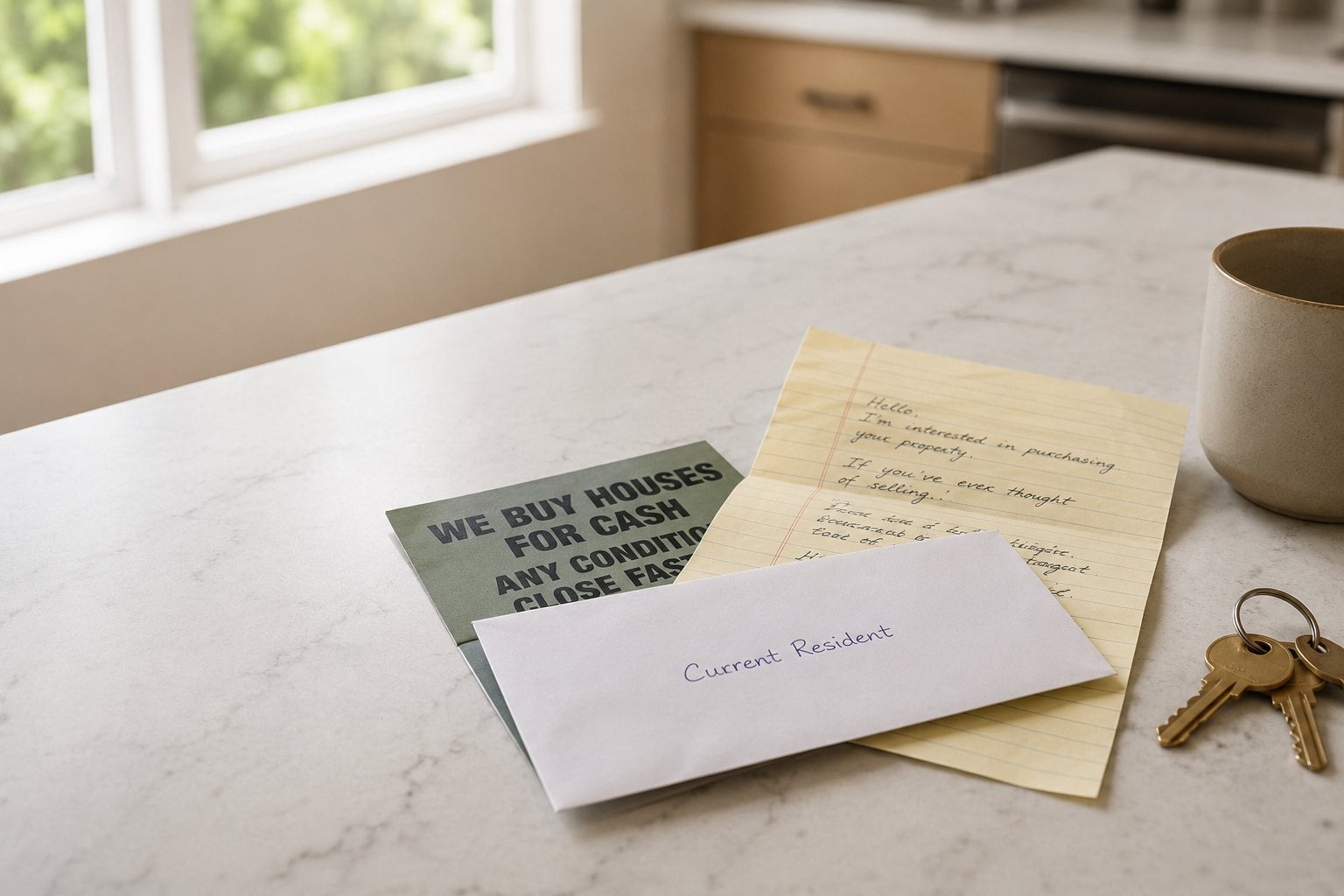
The pitch in those letters is always speed and certainty. Cash, no inspection, close in two weeks, no repairs, no showings.
Here is the problem with that pitch in Reston. Detached homes here averaged nine days on market in July 2026 and sold at an average of 102.3 percent of what sellers originally asked. Townhouse days on market ran 13. The speed a cash buyer is selling you is speed the open market already delivers, and the open market pays tens of thousands more for it, or well past $200,000 depending on what you own.
That does not make every letter worthless. Some homeowners have a good reason to take one, and this post covers those. But you should know what you are being offered before you answer, and Virginia changed the rules on one category of sender in 2024.
Why the letters keep coming
The 2022 version of this story was a frenzy. Buyers outnumbered sellers, and people knocked on doors because nothing was listed.
The 2026 version is different. Direct mail campaigns run on purchased property data, and they scale to entire zip codes cheaply enough that a low response rate still pays. Owner-occupied, long tenure, no recent mortgage activity, an older build year: that profile puts you on a list. It says nothing about your house and everything about a spreadsheet.
Reston detached inventory adds a second reason. Fourteen detached homes above $1 million sold in Reston in July against 14 sitting at month end, which works out to one month of supply. Investors chasing that segment cannot buy what is not listed, so they write to owners directly.
If you own in the older Reston clusters or in the parts of Herndon and Oak Hill built in the 1970s and 1980s, you are on more lists than your neighbors in newer construction. Age of housing stock is a commonly used filter in these campaigns.
Herndon runs a little slower and the calculus shifts with it. Across the 20170 zip code, homes sold at a median near $720,000 for the three months through June 2026, with a median of 32 days on market across all property types. Homes still closed at 100.7 percent of list and 47.6 percent went above asking. That 32 days is a median across every home type over a rolling quarter, so it does not line up cleanly against Reston’s nine-day detached average, but the direction is clear enough: a cash buyer’s speed argument has more to work with in Herndon, and the market is still paying full freight for anyone willing to wait out the month.
Four kinds of sender, and how to tell them apart
The buy-and-hold investor. Wants a rental. Pays the most of the investor group, generally 80 to 85 percent of after-repair value less repairs. Usually a real company with a real portfolio.
The flipper. Buys, renovates, resells. Works off the 70 percent rule, meaning the offer targets roughly 70 to 75 percent of after-repair value minus the renovation budget. Industry surveys put the ceiling around 80 percent of after-repair value for most flippers, with a majority capping around 70 percent.
The wholesaler. Usually does not intend to close on your house themselves. Gets you under contract at a low price, then assigns that contract to an actual investor for a fee. Offers here run lowest, frequently 50 to 60 percent of after-repair value less repairs, because the wholesaler’s profit comes out of the spread. This is the category Virginia legislated in 2024.
The iBuyer or the actual buyer. iBuyers make algorithmic offers around 90 to 92 percent of market value, then subtract a service fee near 5 percent and deduct for repairs found during inspection, so the number you sign is lower than the number in the email. Separately, a real buyer working with an agent sometimes writes to a specific house they want. That letter reads differently, because it names your house and says why.
What Virginia changed in 2024
The General Assembly amended the definition of a real estate broker. Under Va. Code § 54.1-2100, the term now covers anyone who, “for compensation or valuable consideration,” among other things “sells or offers to sell, buys or offers to buy, negotiates, or otherwise deals in real estate contracts, including assignable contracts, on two or more occasions in any 12-month period.” The statute was amended in 2024 by chapters 327, 352, 459, and 621.
Read that against how wholesaling works. Someone doing this as a business assigns contracts repeatedly and gets paid for it, which is the conduct the amended definition now reaches. Whether a particular wholesaler is nonetheless exempt as an owner under § 54.1-2103, which covers people acting with reference to property they own, is a fact question that the 2024 changes left for courts and the Real Estate Board to work out.
The stakes are not trivial. Under § 54.1-111, willful unlicensed practice is a Class 1 misdemeanor, and a third conviction within 36 months is a Class 6 felony. Civil penalties run $200 to $5,000 per violation, capped at $25,000 a year.
Two questions cost you nothing and tell you a great deal.
Are you licensed in Virginia, and what is your license number? You can check any answer in about thirty seconds through the DPOR license lookup. An investor buying for their own portfolio generally does not need a license, and will say so plainly. Someone running assignment volume is in murkier territory and should be able to explain where they stand.
Do you intend to assign this contract? A straight answer tells you whether you are negotiating with your buyer or with a middleman whose profit comes out of your price.
We are agents, not attorneys, and none of this is legal advice. If a letter turns into a real conversation, a Virginia real estate attorney is worth an hour of your money.
The part that costs you money
Round numbers against Reston’s July 2026 medians, assuming a conventional sale nets about 94 percent of price after roughly six percent in combined commission and seller closing costs. The 70 to 80 percent band is a modeling midpoint across the sender types above, not a figure any one of them publishes.
| Your home | Reston median | Typical cash offer at 70 to 80 percent | What you give up |
|---|---|---|---|
| Detached | $1,106,625 | $774,638 to $885,300 | $155,000 to $266,000 |
| Townhouse | $709,000 | $496,300 to $567,200 | $99,000 to $170,000 |
| Condo | $391,000 | $273,700 to $312,800 | $55,000 to $94,000 |
Those gaps already account for the commission you would not pay on a cash sale. The discount is the product, not a fee you are avoiding.
Two caveats on that table. The investor percentages are shares of after-repair value before repairs come off the top, so they line up with current value only for a home in move-in condition. And Reston is a small market. July produced 22 detached sales, so a single month of medians moves around more than the tidy numbers suggest. Treat the table as the shape of the trade rather than a quote.
An iBuyer lands better than an investor and still costs real money. Ninety percent of value less a five percent service fee puts a Reston townhouse around $606,000 before any repair deduction, roughly $60,000 under a normal net.
The comparison shifts by segment, and not in the direction most people assume. Reston condos averaged 26 days on market in July at 98.3 percent of original list, against 108 active listings. That is the slowest segment in town, so the speed argument carries the most weight there. It is also the segment where the dollar gap is smallest. Detached is the reverse: the largest gap, and the least need for anyone’s help selling quickly.
When taking one actually makes sense
Four situations where the discount buys something worth having.
The house needs work you cannot or will not do. A property with a failed system, significant water damage, or thirty years of deferred maintenance draws a smaller buyer pool and a rougher inspection negotiation. Selling as-is to someone who prices the work in can beat carrying it while contractors reschedule.
You inherited it and live somewhere else. Estate sales carry costs that do not show up in a net sheet: travel, the emotional weight, coordinating siblings, insurance on a vacant house, and a Virginia probate process that takes its own time. Certainty has real value here.
Your timeline is bound to another purchase. If you are buying a house that will not wait, closing certainty can be worth paying for. Note that a rent-back on a conventional sale often solves the same problem for far less.
Privacy. Some people will not put their home on the internet with twenty photographs of their bedrooms, and no net sheet argues them out of it.
Outside those cases, a Reston homeowner whose house is in reasonable condition is trading somewhere between $55,000 and $266,000, depending on segment, for a few weeks.
If you want to take one seriously, do these four things
Some of these offers deserve a real look. Handle them the way you would handle any other buyer, which is to say skeptically and in writing.
Require proof of funds before you negotiate. A current bank statement or a letter from the institution holding the money, dated within the last thirty days, naming the entity that will appear on the contract. A screenshot is not proof of funds. Neither is a letter from a lender, which means the buyer is financing and the word cash is doing work it has not earned.
Get a net sheet both ways. Not a price comparison, a net comparison. What you walk away with from the cash offer against what you walk away with from a conventional sale at a realistic list price, with commissions, transfer taxes, association fees, and any repair credits subtracted from both. The gap is frequently different from what either side assumed, and occasionally it favors the cash offer.
Control the assignment. If you sign a contract that permits assignment, you have agreed to sell to whoever the original party hands it to, and you may never meet them. A clause requiring your written consent to any assignment costs nothing to add and keeps you dealing with the party you evaluated.
Put a short fuse on the due diligence period. Some cash buyers write an attractive number, tie up your house for three weeks, then return with a renegotiation based on inspection findings. A tight inspection window and a meaningful earnest money deposit filter out the ones who were never going to close at the number they wrote.
If a buyer objects to all four, that tells you what you needed to know.
How to respond, three ways
Ignore it. No obligation exists. Unanswered mail stops eventually, and no legal exposure comes from silence. Many homeowners land here, and it is a perfectly good answer.
Stop the flow. Put your number on the National Do Not Call Registry, which is free and covers telemarketing calls. For mail, DMAchoice lets you opt out of commercial marketing mail for a $6 fee good for ten years, and OptOutPrescreen handles prescreened credit and insurance offers at no cost.
Set expectations, though. DMAchoice only binds participating marketers, and investors mailing off county property records are not among them. Those letters will keep coming. What these tools cut is the general marketing volume around them.
Use it as information. A letter is a signal that someone with capital thinks your house is worth pursuing. That is worth knowing. Ask an agent for a current valuation before you engage with the sender, so any number they name lands against something real rather than against a guess.
Signals worth taking seriously
Many of these letters come from legitimate businesses making low offers, which is different from fraud. A few warning signs still matter.
Pressure to sign quickly, or an offer described as expiring in days, is a negotiating tactic rather than a market condition. Any request for money up front, whether framed as an application fee, a processing fee, or an earnest money handling charge, is a stop sign. So is refusal to meet in person or to name the entity buying the property. And any request to sign a document you have not read in full, from anyone, at any price.
Verify who is on the other end. A company name run through the Virginia State Corporation Commission business search, plus a DPOR license lookup, takes five minutes and settles most questions. An entity registered three weeks ago in another state, with no Virginia registration and no license, is worth a longer look before you sign anything.
One more pattern worth naming. A letter that already contains a specific dollar figure, before anyone has seen the inside of your house, is not an offer. It is an opening position generated from public records, and it is commonly revised downward once someone walks through. Treat the number in the envelope as marketing.
The short version
The letters are real, the money is usually real, and the price is usually 70 to 80 percent of what your house is worth. On a Reston townhouse that gap runs $99,000 to $170,000, and on a detached home it runs $155,000 to $266,000.
You are being sold speed and certainty in a market where detached homes already go under contract in nine days at an average of 102.3 percent of original list. If your house needs significant work, or you inherited it from three states away, that trade can make sense. Otherwise it rarely does.
Before you reply to one, ask what your home is actually worth today. We will tell you, and we will also tell you if the cash offer is the better deal, because sometimes it is.