
Hunter Mill District Supervisor Walter Alcorn opened his August 12 newsletter with an idea he calls Universal Basic Housing, and he asked readers to email him their reactions.
The frame comes from Universal Basic Income, which economists and Silicon Valley investors have debated for years as a response to job losses from automation and AI. Alcorn flipped it. Instead of sending everyone a check, he wants the county to house the 1,365 people it counted as experiencing homelessness this year, and he pointed to the more than 750,000 people unhoused nationally.
His version pairs permanent housing with the services that keep people in it. He named the building types he has in mind: studio apartments, managed dormitories, rehabilitated existing housing stock, and commercial space converted to residential. Social workers call this permanent supportive housing. Alcorn wants it extended to everyone who needs it rather than to whoever reaches the front of the waiting list.
He listed the obstacles himself. Building codes and land use rules would have to change. Someone would have to write eligibility rules and conduct standards. Prevention programs would need more money. And Fairfax County would have to run all of it at a scale it has never attempted while still treating residents as individuals.
The number behind the proposal
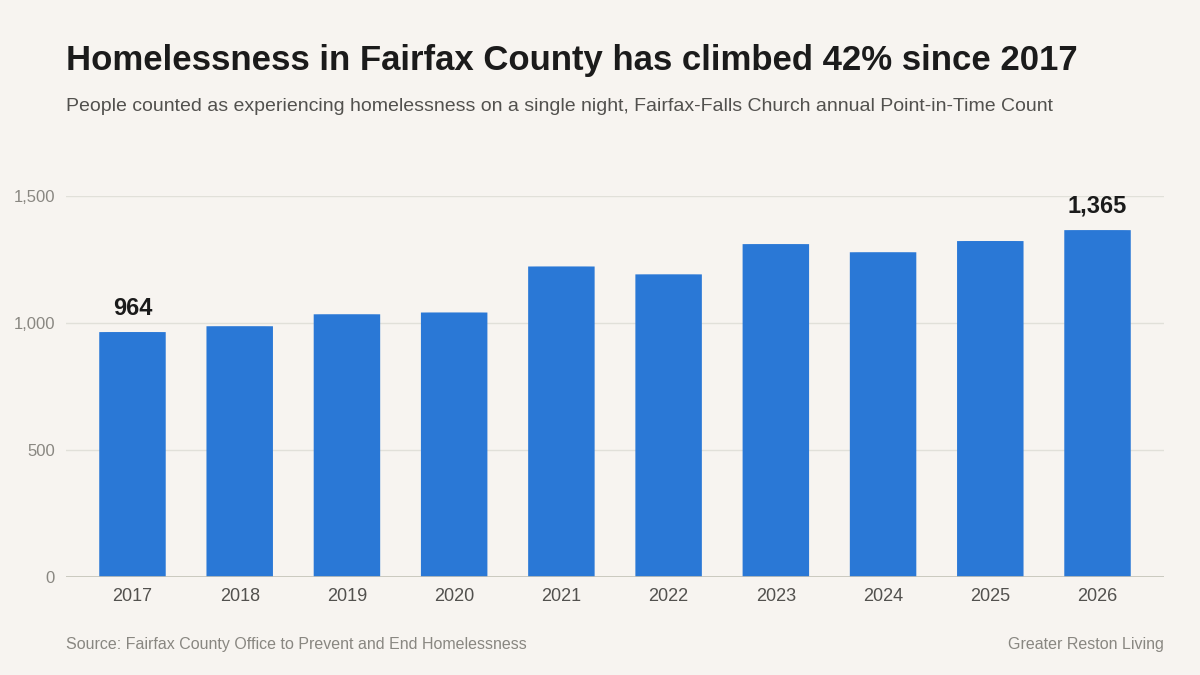
Volunteers counted 1,365 people in emergency shelters, transitional housing, and outdoors on the night of February 4 during the 2026 Point-in-Time Count, which Fairfax County conducts alongside the cities of Fairfax and Falls Church.
That total rose 3 percent from 1,322 in 2025. It climbed 32 percent from 2019, and from 964 people in 2017.
| Year | People counted |
|---|---|
| 2017 | 964 |
| 2018 | 987 |
| 2019 | 1,034 |
| 2020 | 1,041 |
| 2021 | 1,222 |
| 2022 | 1,191 |
| 2023 | 1,310 |
| 2024 | 1,278 |
| 2025 | 1,322 |
| 2026 | 1,365 |
Fairfax-Falls Church Point-in-Time Count totals, 2017 through 2026. Source: Fairfax County Office to Prevent and End Homelessness.
The 2026 breakdown:
- Chronic homelessness among adults jumped roughly 22 to 24 percent in a single year, depending on the source. Chronically homeless adults now account for about a quarter of all adults counted.
- Children under 18 made up 28 percent of everyone counted.
- A quarter of the people counted held jobs.
- Households with children shrank 8 percent while adult-only households grew 15 percent.
Alcorn's proposal aims hardest at that first category. Short-term shelter and rapid re-housing cycle chronically homeless adults through the system without resolving much, and permanent supportive housing carries the strongest track record with that group.
The count itself runs low. A single February night misses families doubled up on a relative's couch. Fairfax County Public Schools applies a broader federal definition that captures those families, and it identified 2,129 students experiencing homelessness in a recent school year.
What we know about Reston specifically
Fairfax County publishes no Reston-only homeless count. The Point-in-Time Count reports at the Fairfax-Falls Church level, not by magisterial district or community, and no public document breaks it down further.
Cornerstones runs the 70-bed Embry Rucker Community Shelter on Bowman Towne Drive, which serves the Reston and Herndon end of the county. In spring 2024, the county cleared an encampment in the woods between the Inova emergency room and the Sunrise Assisted Living Center. Alcorn called it the largest encampment in Fairfax County. FFXnow reported 20 to 35 people living there, and Reston Strong, the volunteer group supporting them, prepared supplies for 40. The county then opened a temporary overnight shelter at 1850 Cameron Glen Drive with room for 99 people, and closed it on April 1, 2025.
Reston and Herndon likely hold dozens of unsheltered people on a given night, alongside a shelter that stays full. Housing dozens is a manageable target. Housing all 1,365 people across the county is the harder version of the same idea.
Reston's obsolete commercial space
Alcorn's list included converting obsolete commercial space, and Reston holds a real supply of it. Owners of 1980s office buildings along Sunrise Valley Drive and elsewhere keep filing rezoning applications to tear them down, because those buildings no longer compete for tenants. Each application opens a conversation about what replaces them.
The county already committed to one version. It plans the replacement for Embry Rucker on Block 5 of Reston Town Center North, next to the North County Governmental Center, on land Inova will transfer through a real estate exchange. The design holds 50 beds for single adults, 10 family units, and 14 permanent supportive housing units across 25,000 square feet, at an estimated $25 million. Construction could finish around 2029.
Alcorn's newsletter asks what it would take to move from 14 units to a number matching the need, and where those units would go. In Reston, that question runs through the same land use process that shapes everything else here.
Cost and location
Alcorn conceded in his newsletter that Universal Basic Housing would come neither cheap nor easy, and he attached no price tag. Researchers have repeatedly found that permanent supportive housing costs less per person than the emergency rooms, jails, and shelter beds that unhoused people cycle through. Savings over ten years still require capital today, and capital in Fairfax County means bond referendums, a tight budget cycle, and competition with school construction and transportation.
Location raises the second obstacle. Every unit needs a specific parcel in a specific neighborhood and a specific approval. Anyone who has sat through a Reston Planning and Zoning Committee meeting can picture those hearings.
How to weigh in
Alcorn asked for reactions by email at [email protected]. His newsletter takes a summer hiatus this week and returns August 26, so you have until then to get your thoughts in front of him before the next edition.
Cornerstones does the day-to-day work in Reston and Herndon, and its volunteer and donation pages offer a closer look at how the local system runs.
We track Hunter Mill land use because what the Board approves here shapes what Reston looks and costs like in ten years. Alcorn's proposal sits at the informal stage now. Ideas like it turn into comprehensive plan amendments two years later, and residents hold far less influence once that process starts.