
For most of Reston’s history, the stretch of low-slung office buildings near Wiehle and Reston Town Center Metro did exactly what they were built to do. They held cubicles, conference rooms, and parking lots. Today many of those same buildings are being measured for a very different future, and the clearest example of that shift is about to reach a decision point at the Fairfax County Government Center.
On June 10, the Fairfax County Planning Commission is scheduled to vote on whether to recommend approval of Lofts II at Reston Station, Pulte Group’s plan to replace three older office buildings with 158 new homes. The Board of Supervisors holds its public hearing on June 23. If you live in Reston, are thinking about buying here, or are weighing when to sell, this is a project worth understanding, because it tells you where the next wave of new construction is landing and what to watch for when you buy into it.
What Pulte is actually proposing
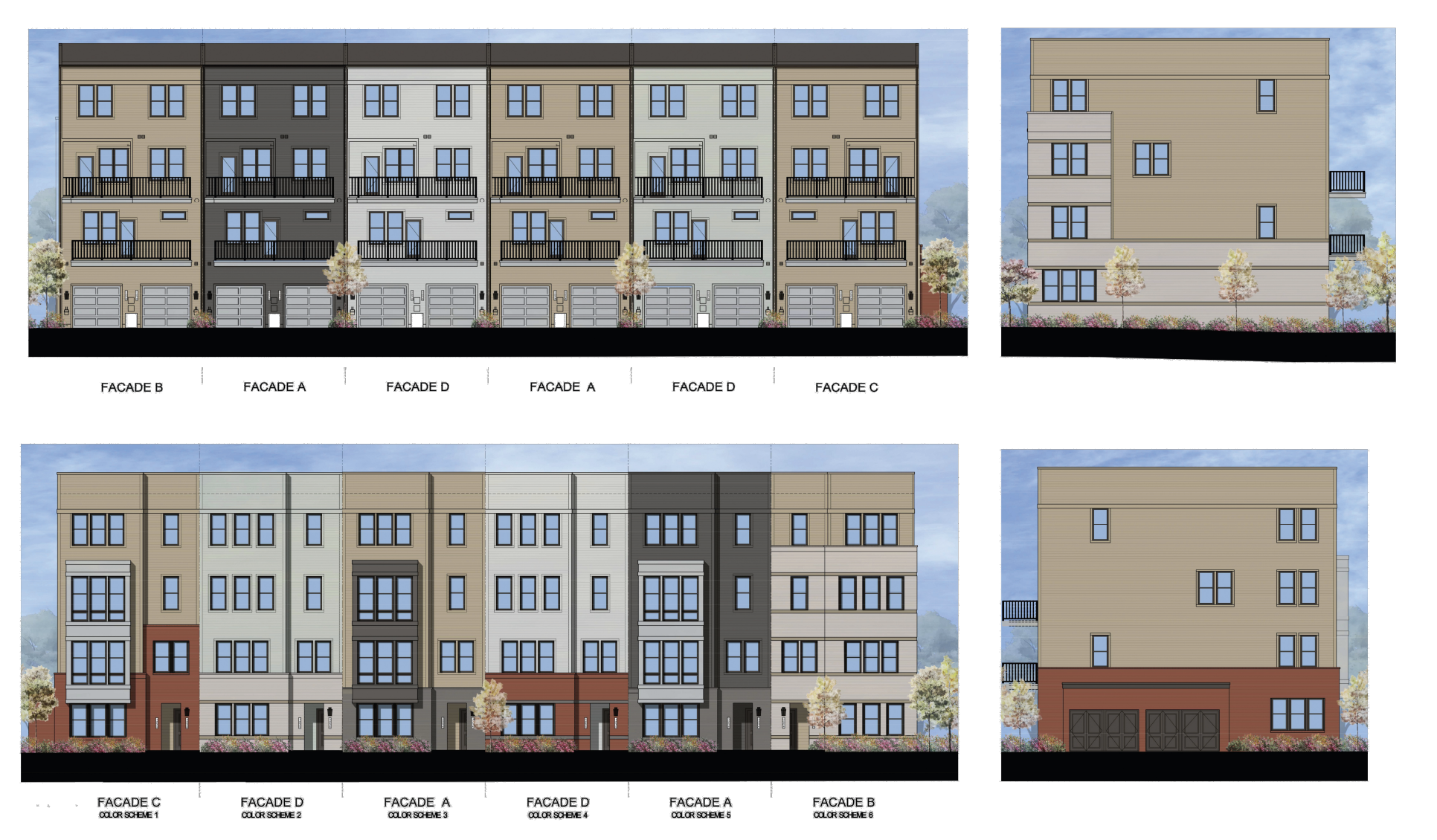
The Lofts II site sits at 1810, 1825, and 1850 Samuel Morse Drive, just north of Reston Station Boulevard and within walking distance of the Reston Town Center Metro station. Pulte wants to take down three low-rise office buildings, all built in the 1980s and including the former Austin-Weston Center for Cosmetic Surgery and the old Society for Nuclear Medicine offices, and put up 158 residences in their place. The plan calls for 112 two-bedroom condominiums spread across three buildings of five and six stories over parking podiums, plus 46 stacked townhouses in a separate four-story building. The development also includes just under half an acre of publicly accessible park space, with a central lawn and a tot lot.
A Fairfax County staff report released on March 18 backed the change, concluding that the proposed development fits the residential character of the area and supports transit ridership. Staff noted what anyone driving through already senses, that this pocket of Reston is turning residential, with the Faraday Park apartments to the south and the partially built Midline at Reston Station to the west. The plan sets the site’s intensity at a floor-area ratio of 1.4, the measure the county uses to compare total building space against lot size, which works out to the 158 homes now on the table.
There is also an affordability component worth noting. Under the draft proffer agreement, at least 12 percent of the homes, roughly 19 units, would be designated workforce dwelling units reserved for households earning up to 70, 80, or 100 percent of the area median income. Pulte’s attorney has argued that lower-density sites a little farther from the platform, like this one, are where the county can actually deliver for-sale workforce housing near Metro rather than rentals.
This is the second phase of a community that started small. The original Lofts at Reston Station opened in 2019 with 44 homes, 32 condos and 12 two-level townhomes, approved by the county back in 2016. Pulte first floated a 90-unit plan for the office parcels in 2019, then reworked it through the county’s site-specific plan process. Phase two has now been redesigned roughly eight times, which tells you how carefully the county scrutinizes density this close to Metro.
The Board of Supervisors already cleared the first hurdle on May 5, approving the comprehensive plan amendment that allows housing on the site at all. What remains is the rezoning itself, which is the document that locks in the details. The Planning Commission has deferred its recommendation on that twice. The most recent delay, to June 10, came after Hunter Mill District Commissioner John Carter introduced a set of last-minute conditions, known as proffers, that he wants Pulte to commit to before the project moves forward.
Why residents are pushing back
The most revealing moments in this process came from residents who already live at Lofts I.
At the May 13 public hearing, members of the Lofts at Reston Station condominium association told the commission that Pulte had fallen short on several promises tied to the first phase. They pointed to inadequate parking caused in part by missing loading spaces, a long delay in striping Reston Station Boulevard for a bike lane, and slow snow removal during the January storm. One board member described calling the builder and waiting for a crew that took its time arriving. Another asked a simple question that should resonate with any buyer: what happens when the developer does not follow through on what it agreed to do?
In response, Commissioner Carter proposed conditions that would require Pulte to provide sidewalks, street trees, and possible on-street parking, stripe lanes and crosswalks on Reston Station Boulevard, remove snow within 24 hours after a storm until the roads are accepted by the state, and help the existing residents clean construction dust off their building. Pulte’s attorney signaled the developer would accept the snow removal and striping conditions, and offered to make a cash contribution so the condo association could hire its own power washing crew rather than rely on the builder.
There is also a road fight running underneath all of this. Easterly Road, which will eventually connect Reston Station Boulevard to Sunset Hills Road, sits right on the property line between the Lofts site and the office building to the north. Pulte and the neighboring landowner have not agreed on who pays to finish it. That disagreement is a big reason the commission pushed its vote to June 10.
The bigger pattern: a corridor, not a one-off
Zoom out, and Lofts II stops looking like a single project and starts looking like the leading edge of a trend. Directly to the north, at 1821 Michael Faraday Drive, a developer called JB Properties has filed its own rezoning to replace the building that currently houses Northern Virginia Community College’s Reston Technology Center. That plan would bring up to 92 more homes, a mix of stacked townhouses and multifamily units. NOVA is set to vacate by the end of 2027.
Add in the nearby Faraday Park apartments and the Townhomes at Reston Station, and a clear picture emerges. The pocket between Sunset Hills Road and Reston Station Boulevard is converting from office park to walkable neighborhood, and it could gain something on the order of 250 new homes over the next several years. Farther south, much larger proposals like Bernstein’s revived Reston Crossing near the Town Center Metro would push that number into the thousands.
For the local housing market, the takeaway is straightforward. Reston is answering its tight inventory not by sprawling outward but by rebuilding its aging commercial cores into for-sale and for-rent housing close to the train. That is good news for buyers who want a new home near Metro and have been frustrated by a thin resale market.
What this means if you are buying
New construction near Metro is appealing, and these projects will give buyers fresh condo and townhouse options in a part of Reston that has been short on them. Before you fall for the rendering, though, the Lofts story offers a practical lesson worth carrying into any new development.
Ask about the proffers and the track record. Proffers are the commitments a developer makes to the county in exchange for approval, covering everything from sidewalks to snow removal to park space. When a builder has a history of missing those obligations after the ribbon is cut, the gap between what was promised and what gets delivered can land on the homeowners association, and eventually on your monthly dues. Read the resale documents carefully, ask who is responsible for road and infrastructure maintenance until the state takes over, and find out whether earlier phases of the same community had complaints. This is exactly the kind of homework we do with buyers, and it matters more in a phased development than almost anywhere else.
What this means if you are selling
If you own a resale home near one of these sites, more rooftops are coming, and so is construction traffic, dust, and noise for a while. That cuts two ways. New supply nearby can compete with your listing, but a more walkable, amenity-rich neighborhood with new restaurants and parks also raises the long-term appeal of the whole area. Timing and presentation matter. If a major project next door is about to break ground, there is often a window to sell before the disruption peaks, and a strategy for positioning your home against shiny new inventory.
What to watch next
The two dates to circle are June 10, when the Planning Commission is expected to act, and June 23, when the Board of Supervisors holds its public hearing. Those meetings will determine whether Lofts II moves ahead and on what terms. Even with an approval, the homes are a few years out. Pulte has told the county it does not expect to start moving dirt until the third quarter of 2027 at the earliest, with construction running about two years after that. We will be following the whole timeline closely, because what gets decided on Samuel Morse Drive is a preview of how the rest of Reston’s office corridors will change in the years ahead.
If you are thinking about buying into one of these new communities, or you own nearby and want to understand how the pipeline affects your home’s value, reach out. Knowing the neighborhood before the cranes arrive is the whole point.